VA 703-457-9028
 Apply for Financing
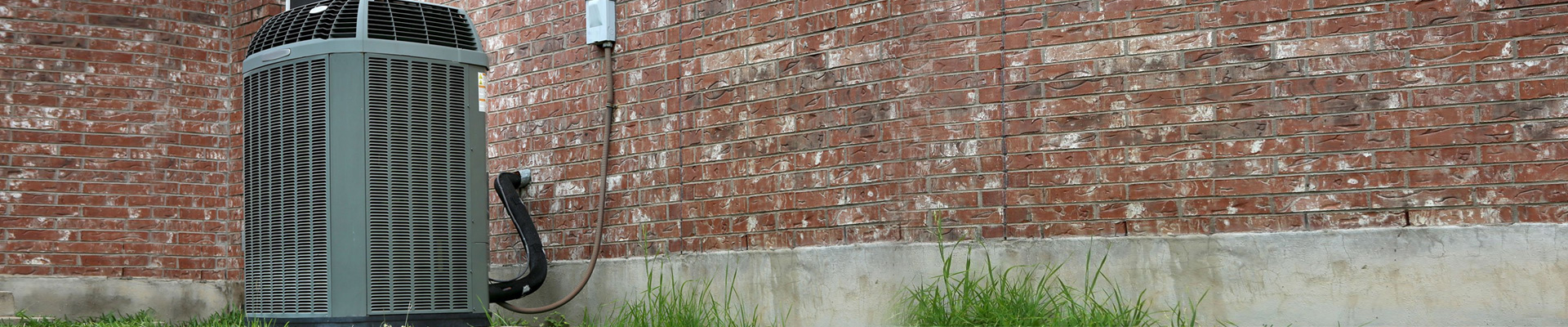
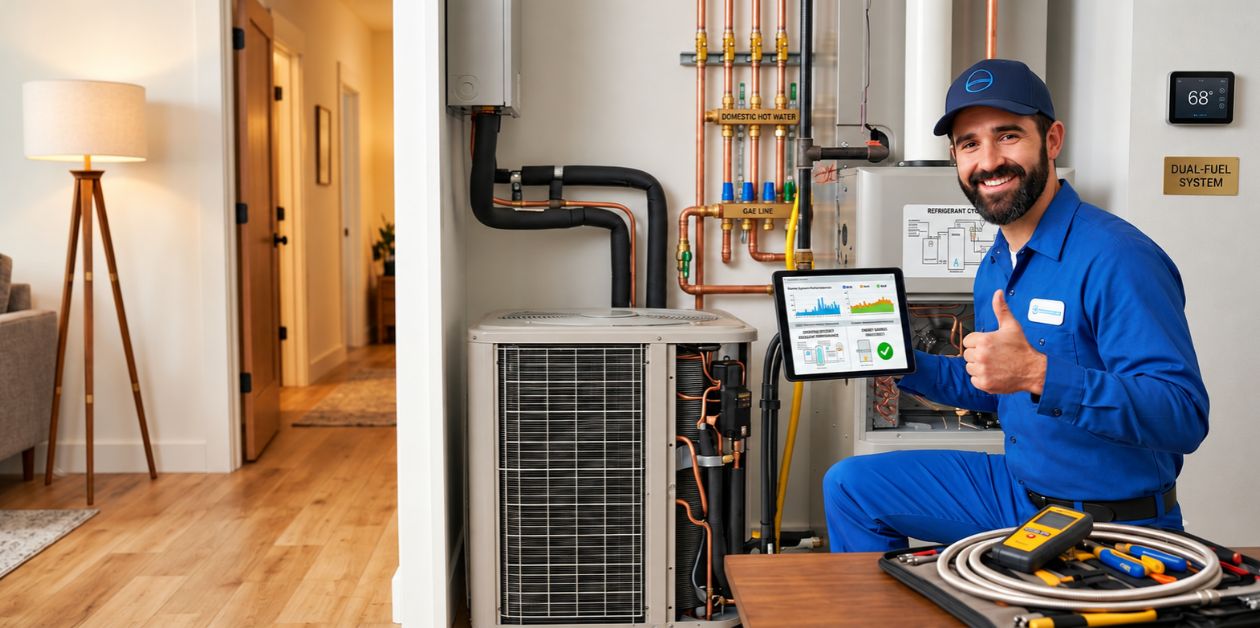
Shopping for a new heating system, or trying to figure out what’s already in your home? One of the most common questions we hear is whether a heat pump runs on gas or electricity. It’s a fair question, because heat pumps work very differently from the gas furnaces many Northern Virginia homes grew up with.
Below, we explain how heat pumps are powered, what refrigerant does, what happens on the coldest days, and how to tell whether an all-electric heat pump or a dual-fuel system is a better fit for your home.
How Does an Electric Heat Pump Work?
A heat pump doesn’t create heat the way a furnace does. It moves heat from one place to another, much like your refrigerator moves heat out of the food compartment. Even cold outdoor air contains heat energy that a heat pump can capture.
- Heating mode: Refrigerant in the outdoor coil absorbs heat from the outside air. The electric compressor pressurizes the refrigerant, which raises its temperature. The hot refrigerant releases that heat indoors, and the blower sends warm air through your ducts.
- Cooling mode: A reversing valve flips the direction of the refrigerant. Now the system pulls heat out of your home and releases it outside, exactly like a central air conditioner.
- Defrost mode: In cold, damp weather, frost can build up on the outdoor coil. The system briefly switches to defrost to melt it. You may see steam from the outdoor unit when this happens, which is normal.
Because a heat pump moves heat rather than generating it, it can deliver two to three or more units of heat for every unit of electricity it uses under mild conditions. The U.S. Department of Energy notes that an air-source heat pump can cut electricity use for heating by roughly 50% compared with electric resistance heat such as baseboard heaters or an electric furnace. For a deeper look, read how a heat pump works.
What Powers a Heat Pump?
Every major component of a standard heat pump runs on electricity:
- Compressor: The heart of the system. Yes, every heat pump has a compressor, located in the outdoor unit.
- Outdoor fan: Moves air across the outdoor coil.
- Indoor blower: Pushes conditioned air through your ductwork, either in an air handler or a furnace.
- Controls and reversing valve: Switch the system between heating, cooling and defrost.
Most central heat pumps need a dedicated 240-volt circuit. The exact breaker size and wiring depend on the unit’s capacity and the manufacturer’s specifications, so your installer should confirm your electrical panel can support it, especially if you’re switching from a gas furnace or oil system.
Do Heat Pumps Use Gas?
A standard heat pump does not use gas. It has no burner, no flame and no flue. The only time gas is involved is when the heat pump is paired with a gas furnace as part of a dual-fuel system, which we cover below. (Gas-fired absorption heat pumps do exist, but they are uncommon in homes and are mostly used in commercial applications.)
Can a Heat Pump Run on Propane?
Not directly. A heat pump itself still runs on electricity. However, homes without natural gas service can pair a heat pump with a propane furnace to create a dual-fuel system. This is a practical option in more rural parts of Loudoun, Fauquier and Prince William counties where natural gas lines aren’t available.
Does a Heat Pump Use Freon?
Heat pumps use refrigerant, but refrigerant is not a fuel. It circulates in a sealed loop and carries heat between your indoor and outdoor coils. It is not burned or used up during normal operation.
“Freon” is a brand name that most people use for refrigerants in general. It historically referred to R-22, which is no longer produced in the U.S. Here’s what you may find in heat pumps today:
| Refrigerant | Where you’ll find it | What to know |
|---|---|---|
| R-22 | Systems installed before about 2010 | No longer produced. Servicing relies on limited reclaimed supply, which can make repairs costly. |
| R-410A | Most systems installed from about 2010 to 2025 | Still widely in use and can still be serviced. New systems are moving away from it under the federal AIM Act. |
| R-454B and R-32 | Most new heat pumps and AC systems | Lower global-warming-potential refrigerants. They are classified A2L (mildly flammable), so installers need the right training and must follow updated codes. |
Because refrigerant isn’t consumed, a heat pump that is low on refrigerant almost always has a leak. Simply “topping it off” doesn’t solve the problem. A proper diagnosis finds and repairs the leak first. If you suspect a refrigerant issue, a professional heat pump repair visit is the right next step.
What Happens When It Gets Really Cold?
As outdoor temperatures drop, there is less heat in the air to capture, so a heat pump’s output and efficiency gradually decline. At the same time, your home loses heat faster. At some point, the heat pump alone can’t keep up, and a backup heat source takes over or helps out.
There are two types of backup heat:
- Electric resistance heat strips (often called auxiliary or “emergency heat”) installed in the indoor air handler. This keeps the system all-electric but uses more electricity when it runs.
- A gas or propane furnace, which turns the setup into a dual-fuel system.
Cold-climate heat pumps with variable-speed (inverter) compressors are designed to keep delivering heat at much lower temperatures than older single-stage models. Northern Virginia and Maryland have a mixed-humid climate, with winter nights that regularly fall into the 20s and occasional colder snaps, so many modern heat pumps can handle most of our heating season on their own. If your heat pump struggles in winter, read why your heat pump may be blowing cold air and why heat pumps freeze up.
What Is a Dual-Fuel Heat Pump System?
A dual-fuel system, also called a hybrid heat pump system, pairs an electric heat pump with a gas or propane furnace. The two share the same ductwork and thermostat, and the system automatically chooses the heat source that makes the most sense for the conditions.
| Season | What runs | Fuel used |
|---|---|---|
| Summer | Heat pump in cooling mode, like a central AC | Electricity |
| Spring and fall | Heat pump in heating mode | Electricity |
| Coldest winter days | Gas or propane furnace | Natural gas or propane (plus electricity for the blower) |
How Does the System Decide When to Switch?
A dual-fuel thermostat or control uses an outdoor temperature sensor and a programmed changeover temperature. Above that point, the heat pump heats your home. Below it, the heat pump shuts off and the furnace takes over. The changeover temperature is usually based on one of two balance points:
- Thermal balance point: The outdoor temperature at which the heat pump’s output equals your home’s heat loss. Below this, the heat pump can’t keep up on its own.
- Economic balance point: The outdoor temperature at which heating with gas becomes cheaper than heating with electricity, based on your local electricity and gas rates and the efficiency of your equipment.
There is no single correct changeover temperature for every home. It depends on your heat pump’s capacity, your home’s insulation and air leakage, your furnace efficiency and current utility rates. A well-configured system will also use the furnace during defrost cycles so you don’t feel cool air from the vents.
Heat Pump vs. Gas Furnace vs. Dual Fuel: A Side-by-Side Comparison
| Factor | All-electric heat pump | Gas furnace + central AC | Dual-fuel system |
|---|---|---|---|
| Fuel | Electricity | Gas or propane for heat; electricity for AC | Electricity most of the year; gas or propane in deep cold |
| Heats and cools? | Yes, one system | Needs two separate systems | Yes |
| Efficiency rating | SEER2 (cooling), HSPF2 (heating) | AFUE (furnace), SEER2 (AC) | SEER2, HSPF2 and AFUE |
| Cold-weather heating | Good with a cold-climate model; backup heat strips for extremes | Strong, steady heat in any weather | Strong; furnace covers the coldest days |
| Needs a gas line and venting? | No | Yes | Yes |
| Upfront cost | Moderate | Moderate | Highest (two heating units) |
| Maintenance | Annual or twice-yearly service | Annual service for each system | Service for both the heat pump and furnace |
| Typical lifespan | About 10 to 15 years | Furnace about 15 to 20+ years; AC about 12 to 15 years | Varies by component |
| Best suited for | Homes without gas; mild to moderate climates; all-electric goals | Homes with gas and an existing furnace in good condition | Homes with gas service that want efficiency plus strong backup heat |
Lifespan depends heavily on installation quality, usage and maintenance. See our guide on the average life expectancy of a heat pump.
Pros and Cons of Each Option
All-Electric Heat Pump
- Pros: One system for heating and cooling; high efficiency in mild weather; no combustion, so no carbon monoxide risk from the heat pump itself; no gas line needed; works with solar panels.
- Cons: Output drops in very cold weather; backup electric heat strips can raise winter bills; runs year-round, so components see more use.
Dual-Fuel System
- Pros: Efficient electric heat most of the year with strong gas heat on the coldest days; flexibility when electricity or gas prices change; built-in redundancy, since the furnace can still provide heat if the heat pump needs repair.
- Cons: Higher upfront cost; requires gas or propane service and proper furnace venting; two pieces of equipment to maintain; controls must be set up correctly to deliver the expected savings.
Which Is Right for Your Northern Virginia Home?
The right answer depends on your home, not on a general rule. Here are the situations we see most often:
- You don’t have natural gas service: An all-electric heat pump, ideally a cold-climate model, is often the simplest choice. A propane furnace can be added for dual fuel if you want combustion backup.
- You have gas and your furnace is in good condition: Replacing only your old AC with a heat pump can turn your current setup into a dual-fuel system, as long as the equipment and controls are compatible.
- Your furnace and AC are both aging: Compare a full dual-fuel system with an all-electric heat pump. Your utility rates, comfort preferences and budget will guide the decision.
- You have no ductwork, or you’re adding a room: A ductless mini-split heat pump may be a better fit than either ducted option.
- Some rooms are always cold: The cause could be ductwork, insulation, airflow or equipment size. It’s worth diagnosing before choosing new equipment.
Gas versus electric also affects repairs and maintenance. Read gas vs. electric furnace repairs and how electric furnaces work for related information.
What to Check Before You Install a Heat Pump or Dual-Fuel System
Whichever direction you choose, a quality installation matters as much as the equipment. Before you sign a proposal, make sure it covers the following:
- A Manual J load calculation so the heat pump and furnace are sized for your home, not just matched to the old equipment. Oversized equipment short-cycles and removes less humidity.
- Ductwork evaluation to confirm your ducts can handle the required airflow (Manual D).
- A matched system with an AHRI reference showing the outdoor unit, indoor coil or air handler, and furnace are rated together.
- Compatible controls, including a thermostat that supports dual-fuel changeover and an outdoor sensor if needed.
- Efficiency ratings you understand: SEER2 for cooling, HSPF2 for heat pump heating, and AFUE for the furnace.
- Electrical, venting and condensate work: a dedicated circuit for the heat pump and proper venting and drainage for a high-efficiency furnace.
- Refrigerant handling: installers trained for A2L refrigerants such as R-454B or R-32.
- Written details: model numbers, changeover settings, warranty terms and labor coverage.
Our heat pump installation team walks through each of these steps with you before any work begins. For cost guidance, see how much a heat pump replacement costs.
A note on incentives: The federal 25C tax credit for heat pumps and furnaces ended for equipment installed after December 31, 2025. Some older articles still mention it. Check your utility and the manufacturer for current rebates, and ask about financing options.
Keeping Your Heat Pump Running Efficiently
Because heat pumps run in both summer and winter, regular maintenance is especially important. We recommend professional service at least once a year, and ideally twice: once before cooling season and once before heating season. Between visits, change or check your filter every 1 to 3 months, keep 2 feet of clear space around the outdoor unit, and clear snow and ice away from it in winter. Learn what heat pump maintenance includes.
Signs that it’s time to call for service include frequent “aux heat” or “emergency heat” messages, ice that doesn’t clear after defrost, the system not switching between heating and cooling, or unusually high electric bills. These symptoms can have several causes, so an inspection is the best way to find the root of the problem. See heat pump not switching modes for more.
Frequently Asked Questions
Is a heat pump gas or electric?
A heat pump is electric. It uses electricity to run its compressor, fans and controls, and it moves heat with refrigerant instead of burning fuel. It can be paired with a gas or propane furnace in a dual-fuel system.
Do heat pumps use gas?
Standard residential heat pumps don’t use gas. Gas is used only when a heat pump is part of a dual-fuel system with a gas furnace, and then only by the furnace.
Does a heat pump use Freon?
Heat pumps use refrigerant. Older systems used R-22, often called Freon. Most systems from about 2010 onward use R-410A, and newer systems use R-454B or R-32. Refrigerant circulates in a sealed loop and isn’t used up, so a low charge means there is a leak.
Is a heat pump the same as an air conditioner?
In cooling mode, a heat pump works just like a central air conditioner. The difference is that a heat pump has a reversing valve, so it can also run in reverse to heat your home.
Does a heat pump use more electricity than a gas furnace?
A heat pump uses electricity, while a gas furnace uses mostly gas plus a small amount of electricity for its blower. Which costs more to run depends on your local utility rates, outdoor temperatures and equipment efficiency. In mild weather, heat pumps are often less expensive to run.
What is emergency heat on a heat pump?
Emergency heat (or auxiliary heat) is backup heat, usually electric heat strips in the air handler or a gas furnace in a dual-fuel system. Auxiliary heat turns on automatically when extra heat is needed. Emergency heat is set manually, usually when the heat pump itself isn’t working.
Can I add a heat pump to my existing gas furnace?
Often, yes. Many homeowners replace their old central AC with a heat pump and pair it with their existing furnace to create a dual-fuel system. The furnace, coil, ductwork and controls must be compatible, so an evaluation is needed first.
Are heat pumps a good choice in Northern Virginia?
Our mixed climate suits heat pumps well, and modern cold-climate models handle most winter conditions. Homes with gas service often choose dual-fuel systems for extra heating power on the coldest days. The best choice depends on your home and energy costs.
Talk to a Local HVAC Company About Your Options
Choosing between an all-electric heat pump and a dual-fuel system comes down to your home, your fuel options and how you want your home to feel. We don’t believe in a one-size-fits-all approach. As a family-owned hvac company northern virginia homeowners have relied on since 1991, AVS Heating & Air Conditioning takes the time to evaluate your system, explain your options clearly and recommend a practical solution.
Whether you need heat pump repair or a installation or advice on a dual-fuel upgrade, our team serves homeowners and businesses throughout Northern Virginia and Maryland. Call 703-457-9028 in Virginia or 301-686-7129 in Maryland to schedule an evaluation.