
 VA 703-457-9028
 Apply for Financing

A new furnace is a big job, but most of the stress comes from not knowing what to expect. A little planning before the crew arrives keeps the work on schedule, keeps your home safe, and gets your heat back on faster.
This guide covers what to do two weeks before, the day before and on installation day, plus the permit and venting questions Northern Virginia homeowners should ask first.
Quick Answer
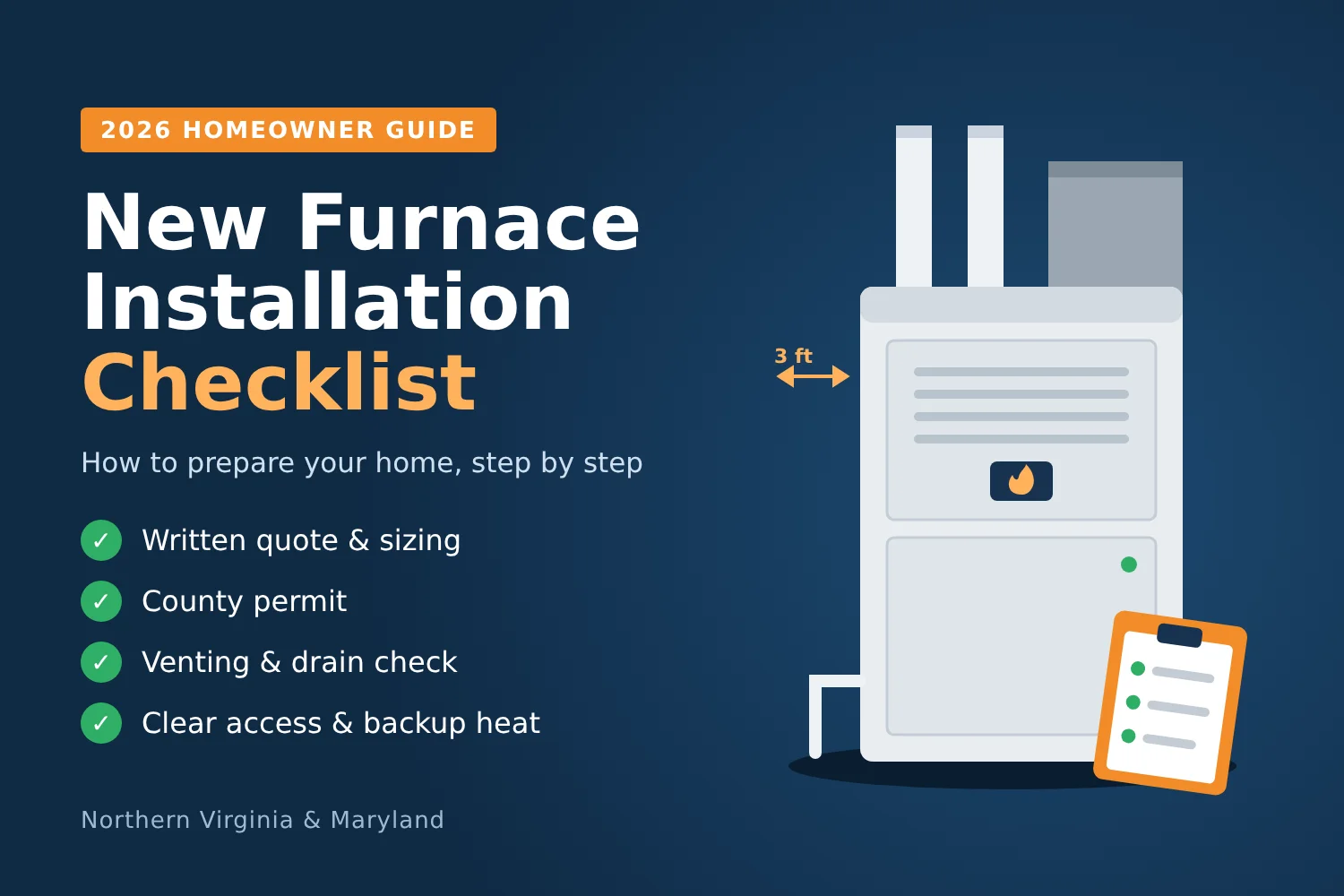
To prepare for a new furnace installation, book an in-home assessment and get a written, itemized quote, confirm your installer will pull the county permit, ask whether your new furnace needs new venting or a condensate drain, clear a 3-foot work area and a path to the unit, and plan a warm room for the hours your heat is off. Most furnace installations take 4 to 10 hours, and a straight replacement often finishes in one day.
| What to prepare | When | Why it matters |
| Written, itemized quote | About 2 weeks before | Confirms equipment, venting, permit and haul-away |
| County permit | Before installation day | Required for gas furnace replacements in Fairfax County |
| Venting and drain check | During the assessment | High-efficiency furnaces vent and drain differently |
| Clear access | The day before | Saves install time and protects your floors and walls |
| Backup heat plan | Installation day | Your heat is off while the old unit comes out |
Getting a new furnace in Northern Virginia or Maryland? AVS offers free estimates and financing on qualifying systems. Call 703-457-9028 (VA) or 301-686-7129 (MD).
New Furnace Installation Checklist: 2 Weeks, 1 Week and the Day Before
Work through this timeline and installation day usually runs without surprises.
| When | What to do |
| About 2 weeks before | Book an in-home assessment and a load-based sizing check. Get a written, itemized quote. Ask whether the permit fee, venting changes and old-unit haul-away are included. Settle financing. |
| About 1 week before | Confirm the date and arrival window. Give your HOA or condo management any required notice. Plan where the work van can park. Arrange care for pets and young children. |
| The day before | Clear the furnace area and the path from the door. Move fragile items. Charge phones and devices. Set up your backup heat plan. |
ConsumerAffairs advises Fairfax homeowners to check that the contractor holds a Virginia DPOR license and will pull the county permit before any work starts. A written scope, a pulled permit and a clear path prevent most installation-day delays.
Gas Furnace, Electric Furnace or Heat Pump: What Each Means for Prep
The heating system you choose decides how much your home needs to change.
| System | Fuel | What it means for prep |
| Gas furnace | Natural gas or propane | Needs a gas connection, proper venting and a permit inspection |
| Electric furnace | Electricity | No gas line or flue, but may need a dedicated electrical circuit |
| Heat pump | Electricity | Heats and cools, with an outdoor unit and an indoor air handler |
Gas furnaces paired with central air or a heat pump are common in Fairfax homes, according to ConsumerAffairs. If you’re still comparing systems, our guide to choosing the right furnace walks through the options.
80% vs 90%+ Efficiency Furnace: How Venting Changes the Installation
This is the detail many homeowners only hear about on installation day. A standard 80% AFUE furnace and a 90%+ condensing furnace vent in completely different ways, and that changes the work, the time and the quote.
| 80% furnace (non-condensing) | 90%+ furnace (condensing) | |
| Venting | Metal Type B vent up through the roof or chimney | PVC pipe, usually out a side wall |
| Uses existing vent? | Usually yes | No, it needs its own vent run |
| Drain needed? | No | Yes, a condensate drain and sometimes a pump |
| Combustion air | Draws air from inside the home | Most are direct vent and pull outside air |
These differences come from a U.S. Department of Energy workshop presentation on condensing and non-condensing gas appliances.
Watch for an orphaned water heater. In many older Northern Virginia homes, the furnace and the gas water heater share one chimney. When a new condensing furnace vents out the side wall, the water heater is left alone in a flue sized for two appliances, which the same DOE presentation flags as a carbon monoxide concern. The usual fix is a properly sized chimney liner. Fairfax County also uses a chimney and vent certification form when a fuel-burning appliance is replaced in an existing home, so ask whether your quote covers the liner and that check.
The 2028 federal furnace rule. Under the DOE standard published in December 2023, non-weatherized gas furnaces made on or after December 18, 2028 must reach 95% AFUE, which effectively means condensing technology. That date still stands, but the rule has been challenged in federal court and DOE is weighing a petition to delay compliance to January 1, 2030. Either way, more replacements will need new venting and a condensate drain, so ask about both before you sign.
How to Prepare Your Home and Clear Access for the Installers
In Northern Virginia, furnaces usually sit in a basement, a utility closet or the attic. Wherever yours is, the crew needs room to work and a clear route in and out.
- Clear about 3 feet around the furnace on every side.
- Clear a path from the entry door to the furnace, including stairs and hallways.
- Move fragile décor, rugs and stored boxes out of the way.
- Make sure the gas shut-off valve and the furnace breaker are easy to reach.
- Keep pets in a closed room away from open doors and tools.
- If you’re upgrading to a condensing furnace, keep the outside wall near the furnace clear for the new vent.
Attic installations: Fairfax attics can pass 130 degrees in summer, according to ConsumerAffairs, so ask about booking attic work for cooler hours.
Condos and townhouses: check your HOA rules before a new vent goes through an exterior wall, since many associations control what can be added to the building.
Winter installations: your heat is off while the old furnace comes out. Set up a warm room for family and pets, and follow the manufacturer’s safety instructions for any portable heater.
Do You Need a Permit for a New Furnace in Fairfax County?
Yes. Fairfax County requires a permit for any gas furnace installation or replacement, even when the new furnace is the same type as the old one.
For a direct replacement with no new gas piping, the county’s Household Appliance (HAPL) permit applies, and it requires one inspection to confirm a code-compliant install. A few details change the permit:
- New gas piping: the project needs a Residential Plumbing permit instead of a Household Appliance permit.
- New or replacement ductwork and larger HVAC work: Fairfax County requires a mechanical permit.
- Other jurisdictions: Arlington, Loudoun and Prince William counties and Maryland jurisdictions set their own rules. Your installer should pull the right permit for your address and tell you when the inspection is booked.
What Happens on Furnace Installation Day?
A professional furnace replacement follows a set order, which explains where the hours go.
| Step | What the crew does |
| 1. Protect and shut off | Covers floors, then shuts off power and gas to the old furnace |
| 2. Remove the old furnace | Disconnects ductwork, gas, electrical and venting, then removes the unit |
| 3. Prepare the location | Checks that existing ductwork fits the new furnace and modifies it if needed |
| 4. Set the new furnace | Positions and levels the unit |
| 5. Make connections | Connects gas, electrical, venting, ductwork and, on condensing units, the condensate drain |
| 6. Start up and test | Fires the furnace and runs safety and performance checks |
| 7. Walkthrough | Shows you the thermostat, the filter and basic care |
This sequence follows Carrier’s furnace installation guide. Your part on the day is simple: stay reachable, confirm where you want the thermostat, and ask when the permit inspection will happen. If you’d like one local team to handle the whole job, AVS provides professional furnace installation across Northern Virginia and Maryland.
Furnace Startup Safety Checks to Ask About Before the Crew Leaves
The final tests separate a furnace that simply runs from one that’s installed correctly. HVAC contractor B. Carlson notes that a complete startup includes setting gas pressure, a combustion analysis with carbon monoxide testing, and measuring airflow and temperature rise against the manufacturer’s specs, and that these last steps are where installs most often go wrong.
Before the crew packs up, ask:
- Was the gas pressure set to the manufacturer’s specification?
- Did you run a combustion analysis and a carbon monoxide test?
- Were airflow and temperature rise measured and within spec?
- Is the thermostat set up for this furnace’s stages?
- When is the county inspection, and do I need to be home?
How Long Does a New Furnace Installation Take?
Most furnace installations take 4 to 10 hours, according to Lennox. A straight swap with ductwork in good shape often takes 4 to 6 hours, while major ductwork changes can stretch the job to one or two days.
| Installation type | Typical time |
| Straight replacement, existing ductwork in good shape | 4–6 hours |
| Replacement with minor duct adjustments | 6–8 hours |
| High-efficiency condensing furnace (new venting and drain) | 6–10 hours |
| Major ductwork modifications | 1–2 days |
The condensing range comes from PickHVAC and the other ranges from Lennox. Expect more time for a tight attic, a new chimney liner or rebuilt ducts. For budgeting, see our furnace installation and replacement costs.
Why Northern Virginia and Maryland Homeowners Choose AVS for a New Furnace
- Free estimates on new heating systems
- Financing through Wells Fargo, including 0% APR for up to 18 months on select units
- Our [VIP Program]: a new high-efficiency system with zero down, free parts maintenance for ten years and one monthly payment
- 24/7 service, 365 days a year
- Trane and Carrier featured, with service for all major brands
- Founded in 1991 and licensed in Virginia (HVAC 2705039269A) and Maryland (HVAC 520714137895, Home Improvement 4192876)
Ready to plan your new furnace? Call 703-457-9028 (VA) or 301-686-7129 (MD), or schedule your free estimate online.
Frequently Asked Questions About New Furnace Installation
Can I pull the furnace permit myself in Fairfax County?
Yes, homeowners can get the permit in their own name. The county still recommends letting a licensed contractor pull it, so a licensed professional is responsible if the work turns out to be defective.
Should I replace my air conditioner at the same time as my furnace?
If both units are old, replacing them together usually makes sense because they share the same blower and ductwork. If your AC is fairly new and working well, replace only the furnace.
Can I stay home during a furnace installation?
Yes, most homeowners stay home during work. Just keep children and pets away from the work area and stay reachable for questions.
Should I clean my air ducts before a new furnace is installed?
Only if they are dusty, dirty or full of renovation debris. Clean, sealed ducts usually don’t need it.
What should I do after my new furnace is installed?
Register the furnace with the manufacturer to activate the full warranty and keep your permit and install paperwork. Change the filter on schedule and book yearly maintenance.
How long does a new furnace last?
A well-maintained furnace usually lasts fifteen to twenty years or more. Yearly maintenance and regular filter changes help it last longer.
