
 VA 703-457-9028
 Apply for Financing
Last updated: October 2026
Gas vs Electric Furnace Repairs: Electric furnaces usually cost less to repair and last longer than gas furnaces, because they have no combustion system. AVS’s pricing guides put the typical electric furnace repair at around $300, while gas furnace repairs generally run $375 to $1,200. Gas furnaces also need more safety checks, because of the risk of gas leaks and carbon monoxide.
| Gas furnace | Electric furnace | |
| Typical repair cost (AVS) | $375 to $1,200 | Around $300 |
| Typical lifespan | 15 to 20 years | 20 to 30 years |
| Most common repairs | Igniter, flame sensor, gas valve, inducer motor, heat exchanger | Heating elements, sequencer or relays, limit switch, breaker |
| Main safety risks | Gas leaks, carbon monoxide | Overheating, electrical problems |
| Maintenance focus | Combustion, gas and venting checks | Electrical and airflow checks |
| Replacement cost (AVS) | $2,000 to $10,000 | $1,000 to $6,000 |
Furnace not heating? AVS provides 24/7 gas and electric furnace repair across Northern Virginia and Maryland, with no extra charge for evenings, weekends or holidays. Call 703-457-9028 (VA) or 301-686-7129 (MD).
Is my furnace gas or electric? How to tell
If you’re not sure which type you have, look at the furnace and the pipes around it:
| What you see | Gas furnace | Electric furnace |
| Gas pipe with a shut-off valve running into the unit | Yes | No |
| Flue or vent pipe (metal or white PVC) leaving the unit | Yes | No |
| A small window showing a flame or pilot | Often | No |
| Heavy electrical supply and no gas line | No | Yes |
When in doubt, check the label on the furnace door, which lists the model number and fuel type.
How gas and electric furnaces differ
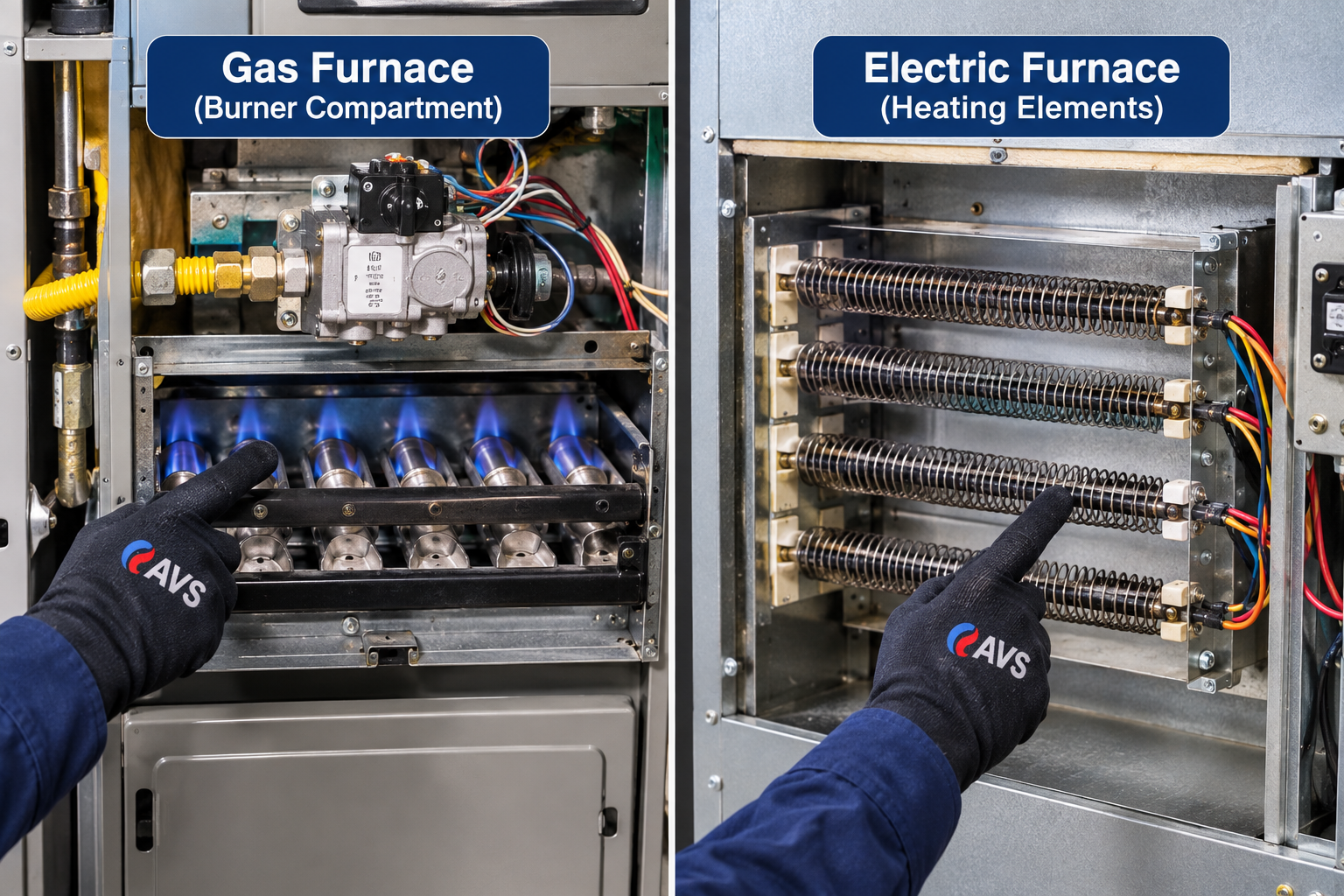
A gas furnace burns natural gas or propane in a burner, and a heat exchanger transfers that heat to the air your blower pushes through the house. The combustion gases leave through a flue or vent.
An electric furnace has no flame. Instead, it passes electricity through heating elements, sometimes called resistance coils, and the blower moves air across them.
That difference drives everything else. As Burton Heating & Cooling explains, burning gas tends to corrode furnace components over time, which is one reason gas furnaces need more maintenance and repairs. Electric furnaces avoid combustion entirely, so they have fewer parts that wear out.
Common gas furnace repairs
Most gas furnace repairs involve the parts that light, prove or control the flame. Prices below are from AVS’s furnace repair pricing guide.
| Part | What you’ll notice | AVS repair cost |
| Flame sensor | Burners light, then shut off within seconds | $75 to $250 |
| Igniter | The furnace runs but never lights | $150 to $300 |
| Thermocouple (standing pilot furnaces) | The pilot won’t stay lit | $100 to $250 |
| Gas valve | Clicking or a glowing igniter with no flame | $200 to $1,000 |
| Draft inducer motor | The furnace won’t get past startup or light | $200 to $1,500 |
| Heat exchanger | Cracks found during an inspection, or a carbon monoxide concern | $100 to $200 to repair, $500 to $1,500 to replace |
Many of these problems show up the same way: the furnace tries to start and shuts down. If your furnace keeps doing that, it may be in ignition lockout, which has several possible causes.
Common electric furnace repairs
Electric furnace repairs are usually electrical rather than mechanical.
| Part | What you’ll notice | Why it fails |
| Heating elements | Weak heat or lukewarm air | Elements burn out over time |
| Sequencer or relays | Some elements never turn on, or the furnace won’t heat | The Furnace Outlet notes sequencers and relays can stick |
| Limit switch | Heat shuts off and comes back repeatedly | Trips when airflow is poor and the furnace overheats |
| Transformer | Controls lose power | Electrical failure (AVS repair cost: $100 to $175) |
| Circuit breaker | The furnace stops working | An electrical fault that needs diagnosis |
| Blower motor | Weak or no airflow from the vents | Wear over time (AVS repair cost: $400 to $1,500) |
Electric furnaces run on high voltage, so even simple-looking electrical repairs should be left to a licensed technician.
Repairs both types share
Some parts appear in both gas and electric furnaces, and AVS prices them the same way:
| Shared part | AVS repair cost |
| Thermostat | $100 to $600 |
| Control or circuit board | $200 to $600 |
| Blower motor capacitor | $150 to $450 |
| Relay switch | $150 to $300 |
| Blower motor | $400 to $1,500 |
Poor airflow damages both types. According to The Furnace Outlet, clogged filters and restricted ducts make heat build up, which stresses heat exchangers in gas furnaces and heating elements in electric ones and causes limit switches to trip. AVS technicians add that if more than 20% of your home’s vents are closed or blocked, the furnace can overheat.
Gas vs electric furnace repair costs compared
According to AVS’s pricing guide, the average furnace repair costs $289, with most homeowners paying between $131 and $458.
| Furnace type | Typical repair cost (AVS) |
| Electric furnace | Around $300 |
| Gas furnace | $375 to $1,200 |
| Oil furnace | $300 to $1,200 |
Gas furnace repairs tend to cost more because, as Mr. Kool Heating & Air explains, gas furnaces often involve more intricate components than electric furnaces. For every part price in one place, see our full furnace repair costs guide.
Safety differences between gas and electric furnaces
| Risk | Gas furnace | Electric furnace |
| Carbon monoxide | Possible, especially with a cracked heat exchanger | None from the furnace itself |
| Gas leaks | Possible at the gas line or valve | None |
| Overheating | Possible with poor airflow | Possible with poor airflow |
| Electrical hazards | Low-voltage controls | High-voltage elements and wiring |
Thiele Heating & Cooling points out that an electric furnace avoids combustion, so there’s no chance of a gas leak or carbon monoxide problem, but it does carry overheating and electrical fire risks. AVS’s pricing guide warns that a cracked heat exchanger in a gas furnace can cause carbon monoxide poisoning and must be taken very seriously.
If you have a gas furnace, Burton Heating & Cooling recommends a properly working carbon monoxide detector that you test periodically. If you ever smell gas, leave your home and call your gas utility from outside before calling for repair.
Cold-weather wear in Northern Virginia
Both furnace types work hardest during cold snaps, but they wear differently. The Furnace Outlet explains that electric resistance heat isn’t as efficient in extreme cold and may run longer to hold the set temperature, which stresses the elements and wiring. FR HVAC notes that gas furnaces can be better at delivering fast, high-capacity heating in colder climates.
Either way, both types benefit from a checkup before the heating season starts.
What about oil furnaces?
Some older Northern Virginia homes still heat with oil. AVS’s pricing guide notes that oil furnaces work much like gas furnaces and often run into the same problems. Oil furnace repairs cost $300 to $1,200 depending on the issue, and oil combustion chamber repairs run $200 to $600.
Should you repair or replace your furnace?
Age and repair cost together point to the right answer.
| Situation | Usually the better choice |
| The furnace is under mid-life and the repair is minor | Repair it |
| The furnace is past mid-life (gas around 10+ years, electric around 12 to 15+ years) and the repair is costly | Consider replacing, as The Furnace Outlet advises |
| The repair costs more than 50% of a new unit | Replace it, per HomeAdvisor’s 50% rule |
According to The Furnace Outlet, citing Angi, gas furnaces typically last 15 to 20 years and electric furnaces 20 to 30 years. On AVS’s pricing guides, replacing a gas furnace costs $2,000 to $10,000, and replacing an electric furnace costs $1,000 to $6,000. See the full breakdown in our furnace installation and replacement costs guide.
Who should repair your furnace?
Gas furnace repairs involve gas lines, valves and combustion testing, so they need a licensed technician who is qualified to work on gas appliances. Electric furnace repairs involve high voltage and should also be handled by a licensed HVAC technician.
AVS provides 24/7 furnace repair for gas, electric and oil furnaces across Northern Virginia and Maryland, with same-day service and no extra charge for evenings, weekends or holidays. Site visits start at $90.
Why Northern Virginia and Maryland homeowners call AVS
- Founded in 1991, with more than 50,000 residential and commercial customers served across the Washington DC metro area
- 24/7 service, 365 days a year, with no extra charge for evenings, weekends or holidays
- Licensed in Virginia (HVAC 2705039269A) and Maryland (HVAC 520714137895, Home Improvement 4192876)
- Call 703-457-9028 (VA) or 301-686-7129 (MD)
Frequently Asked Questions
Do electric furnaces need annual maintenance?
They need less than gas furnaces, but a yearly check still helps. The Furnace Outlet notes that electric furnaces don’t require the same regular professional maintenance as gas units, while Thiele Heating & Cooling says skipping service can shorten an electric furnace’s life and raise operating costs. A yearly electrical and airflow check is a sensible middle ground.
Is an electric furnace cheaper to run than a gas furnace?
Usually not. Electric furnaces are often cheaper to buy and install, but FR HVAC notes that in many regions natural gas is cheaper per unit of heat than electricity, and Topline Air points out that electric furnaces use more energy, so fuel costs tend to be higher. Actual costs depend on your local gas and electric rates.
How many heating elements does an electric furnace have?
Most have between two and five. HomeGuide notes that most electric furnaces have two to five heating-element coils, also called resistance coils. When one burns out, the furnace keeps running but produces less heat, which is why weak or lukewarm heat is a common sign of a failed element.
What does a sequencer do in an electric furnace?
It turns the heating elements on one at a time. Yelp’s cost guide explains that sequencers keep more than one heating coil from turning on at the same time, which prevents an overloaded electrical circuit. Sequencers tend to last 12 to 15 years, and a failed one can leave some elements off or the furnace without heat.
Can I switch from a gas furnace to an electric furnace, or the other way around?
Yes, but it usually costs more than replacing like for like. Today’s Homeowner notes that if a home already has gas lines or the right electrical setup, sticking with the same furnace type may be more cost-effective. Switching typically means adding or capping a gas line, upgrading electrical service or changing the venting.
