
 VA 703-457-9028
 Apply for Financing
Last updated: October 2026
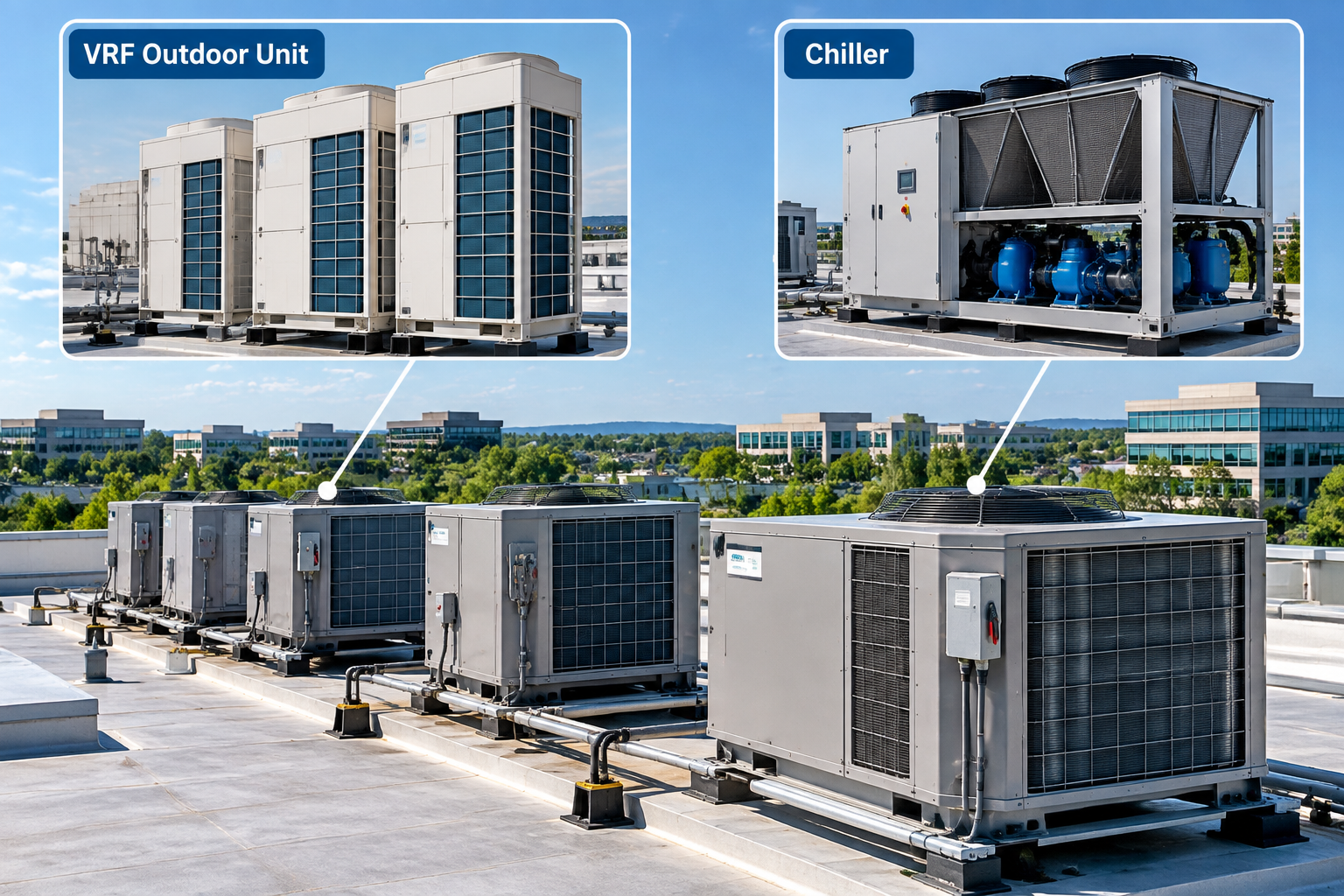
The best AC system for a large building depends mainly on its size, how many separate zones it has, and how much space you have on the roof and inside for equipment. As a general guide, packaged rooftop units suit open spaces and smaller commercial buildings, VRF systems suit mid-size buildings with many zones, and chilled-water systems suit the largest facilities with steady, high cooling loads.
| System | Typical best fit | Zone control | Upfront cost | Typical lifespan | Space needed |
| Packaged rooftop unit (RTU) | Open-plan buildings, retail, warehouses, gyms | Low to moderate | Lower | 15 to 20 years | Roof only |
| Split system | Smaller commercial spaces and individual areas | Low to moderate | Lower | Varies by system | Outdoor unit plus indoor air handler |
| VRF system | Offices, schools, mixed-use buildings with many zones | Very high | Higher | 15 to 20 years | Small outdoor footprint |
| Chilled-water system | Large facilities, hospitals, campuses | High | Highest | 25 to 30+ years | Mechanical room, plus cooling towers if water-cooled |
Lifespans from Whitescarver Engineering’s Virginia commercial HVAC comparison.
Planning a new system or replacing an old one? AVS installs, repairs and replaces commercial HVAC systems across Northern Virginia and Maryland. Call 703-457-9028 (VA) or 301-686-7129 (MD).
What makes large spaces hard to cool?
Large buildings don’t behave like big houses. Several factors make them harder to cool evenly:
- Uneven heat gain. Whitescarver Engineering points out that an administrative wing, server room, assembly floor and public atrium each have different heat gain, occupancy schedules and sun exposure.
- Part-load operation. Most of the year, a commercial system runs well below its full capacity, so efficiency at part load matters as much as peak capacity.
- Ventilation needs. Large occupied spaces need a steady supply of fresh outdoor air, which has to be cooled and dehumidified.
- Humidity. Whitescarver Engineering notes that Virginia’s humid summers and unpredictable spring and fall shoulder seasons make managing indoor humidity just as important as hitting the set temperature, since excess moisture leads to air quality problems and discomfort.
The right system is the one that handles these loads for your specific building, not simply the biggest one.
Rooftop packaged units (RTUs)
Rooftop units put the compressor, condenser, air handler and often the heating section in one weatherproof cabinet on the roof, then send conditioned air through ductwork to the space below.
| Pros | Cons |
| Frees up indoor floor space | Limited zone control in large, varied buildings |
| Factory-built and simpler to install | Heavy units may need roof structural work |
| One unit failing doesn’t shut down the whole building | Can struggle with humidity in mild, damp weather |
| Lower upfront cost | Lower efficiency than VRF or chilled water |
Whitescarver Engineering describes RTUs as a common choice for retail, single-story light industrial and open-plan commercial buildings, and notes that a standard RTU can struggle with humidity during mild, humid shoulder seasons when cooling demand drops but moisture stays high. Hot-gas reheat options can help.
On older buildings, swapping in a larger or heavier rooftop unit can require a structural review of the roof before installation.
VRF systems
Variable refrigerant flow (VRF) systems send refrigerant directly to small indoor units in each zone, rather than pushing air through large ducts. Inverter-driven compressors adjust their speed to match demand.
Why VRF stands out:
- Room-by-room control. One outdoor system can serve many indoor units, each with its own setting.
- Heat recovery. Heat recovery VRF can heat some zones while cooling others at the same time, moving heat from where it isn’t needed to where it is.
- Energy savings. Sensibo cites an Oak Ridge National Laboratory study that found VRF systems saved 15% to 42% on HVAC site energy compared with rooftop VAV systems.
- Better humidity control. Whitescarver Engineering notes that VRF coils run at continuously variable temperatures, helping remove moisture at partial loads, which matters in Virginia’s humid climate.
Trade-offs: VRF costs more upfront, needs technicians trained on the specific manufacturer’s equipment, and usually requires a separate system to bring in and condition fresh outdoor air. Refrigerant line lengths and elevation differences also have to stay within the manufacturer’s limits.
Chilled-water systems
A chiller doesn’t cool air directly. It cools water, which is pumped through pipes to air handlers and fan coil units throughout the building.
| Air-cooled chiller | Water-cooled chiller | |
| How it rejects heat | Fans release heat to outdoor air | A cooling tower and condenser water loop |
| Efficiency | Good | Highest, especially at large scale |
| Space | Smaller, can sit outdoors or on a roof | Needs a mechanical room and cooling tower space |
| Water treatment | Not needed | Required for the tower and condenser loop |
Whitescarver Engineering notes that water-cooled chillers excel in facilities over 50,000 square feet that need continuous, high-tonnage cooling, while air-cooled chillers avoid cooling towers and water treatment at a small efficiency cost. Chiller plants also offer the longest service life of the three main options.
Ductless and split systems for halls and large rooms
Not every large space needs a full commercial central plant. For a single large room, such as a church sanctuary, event hall, gym or community room, the choice often comes down to:
- A rooftop unit, if the building already has a suitable roof and ductwork for one large zone. Whitescarver Engineering notes that standard RTUs traditionally serve single large zones such as a gymnasium, warehouse or open retail floor.
- Split or ductless systems, if there’s no ductwork, the roof can’t take a heavy unit, or the room is used at different times from the rest of the building.
- VRF, if the hall is part of a larger building with offices, classrooms or meeting rooms that each need their own control.
Best AC system by building type
| Building type | Often the best fit | Why |
| Warehouse or light industrial | Rooftop units | Large open zones, simple layout |
| Retail store | Rooftop units | Open floor plan, roof-mounted equipment frees floor space |
| Gym or event hall | Rooftop unit or split system | One large zone with occupancy that varies |
| Office building | VRF | Many rooms and wings that need separate control |
| School or educational building | VRF | Many zones and quiet indoor units |
| Mixed-use building | VRF or a hybrid | Different tenants and schedules |
| Hospital, campus or very large facility | Chilled water | Steady, high cooling loads and long service life |
Based on the system applications described by Whitescarver Engineering, along with general commercial HVAC selection guidance.
Many large facilities combine systems. A chiller can cover the main load, VRF can serve office wings, and rooftop units can handle open areas like cafeterias or storage bays.
How to choose the right AC system for a large building
Work through these questions with your HVAC contractor:
- How big is the building, and how many floors? Square footage is the first filter for system type.
- How many zones need separate control? More zones point toward VRF or chilled water.
- What can the roof support? Heavy rooftop units may need structural work.
- Is there indoor space for mechanical equipment? Chillers need a plant room; RTUs and VRF largely don’t.
- How will fresh air be handled? Ventilation and humidity control need a plan, especially with VRF.
- What matters more, first cost or lifetime cost? Higher-efficiency systems usually cost more upfront but less to run.
- How much downtime can the business tolerate? Plan the installation around your operating hours.
Planning a replacement without shutting down your business
For most businesses, the hardest part of replacing a large system is staying open while it happens. Before work starts, ask your contractor:
- Can the work be phased, one section or unit at a time?
- Can noisy or disruptive work be scheduled after hours or on weekends?
- Will temporary cooling be needed, and who arranges it?
- What permits and inspections are required, and how long do they take?
- What’s the plan if the existing system fails before the replacement is ready?
A clear schedule agreed in writing protects your operations, tenants and customers. For ongoing coverage once the new system is running, see what to look for in commercial HVAC service contracts.
Why Northern Virginia businesses call AVS
AVS provides commercial HVAC installation, repair and replacement for businesses across Northern Virginia and Maryland, with 24/7 service and no extra charge for evenings, weekends or holidays. Businesses in Fairfax can also see our local commercial AC repair in Fairfax page, and our essential guide to commercial HVAC in Northern Virginia covers maintenance and choosing a contractor.
- Founded in 1991, with more than 50,000 residential and commercial customers served across the Washington DC metro area
- Licensed in Virginia (HVAC 2705039269A) and Maryland (HVAC 520714137895, Home Improvement 4192876)
- Call 703-457-9028 (VA) or 301-686-7129 (MD)
Frequently Asked Questions
How much more does a VRF system cost than rooftop units?
VRF installations typically cost 20% to 40% more than comparable rooftop unit or split-system projects, according to Sensibo, and they need technicians certified by the equipment manufacturer. In return, VRF can cut HVAC energy use significantly in buildings with many zones, so the right choice depends on how long you plan to own the building.
Can one building use more than one type of AC system?
Yes, and many large facilities do. Whitescarver Engineering explains that hybrid setups are common in large Virginia facilities: a central chiller handles the steady base load, VRF serves office wings that need separate control, and rooftop units condition large open areas like lobbies or cafeterias.
How heavy is a commercial rooftop unit?
Heavier than many owners expect. Whitescarver Engineering notes that a 20-ton rooftop unit often weighs between 2,500 and 3,500 pounds, which can require structural roof reinforcement during retrofits. Have a structural check done before replacing an older unit with a larger or heavier one.
Do commercial buildings in Virginia need a dedicated outdoor air system?
Often, yes. Whitescarver Engineering notes that because Virginia requires strict adherence to energy codes, a dedicated outdoor air system (DOAS) is often required alongside the main HVAC equipment. It conditions and dehumidifies incoming fresh air, so the primary system can focus on cooling the space.
Which AC system is best for a warehouse or large open space?
For warehouses and large open spaces, packaged rooftop units (RTUs) are often a suitable option because they can efficiently serve large single-zone areas while keeping equipment on the roof and freeing indoor space. The best choice still depends on building size, layout, ventilation needs and cooling requirements. Pasted markdown
How long does a commercial HVAC system usually last?
The lifespan of a commercial HVAC system depends on the equipment type, maintenance and operating conditions. As a general guide, rooftop units and VRF systems often last around 15 to 20 years, while chilled-water systems can last 25 to 30+ years with proper maintenance. Pasted markdown
