
 VA 703-457-9028
 Apply for Financing

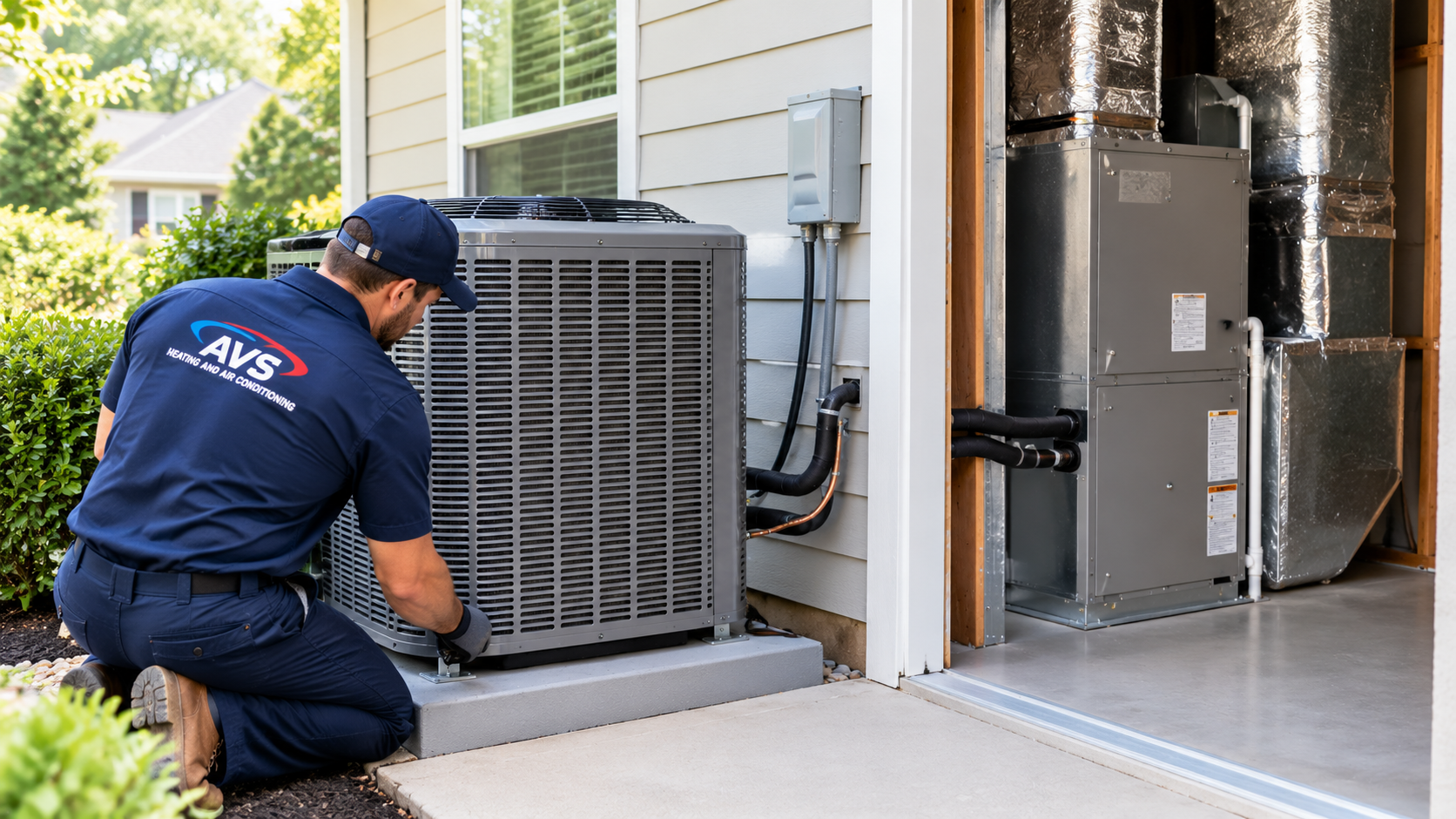
Central air installation with existing ductwork usually takes one day when the ducts are in good shape, because the crew only swaps the outdoor condenser, the indoor coil, the line set and the controls. If the ducts need modifications, the electrical needs an upgrade or you switch system types, plan on two to three days. AVS puts the price at $4,350 to $5,910 for a typical install on good ducts, and AC replacement starts from $2,650. To get your exact timeline and price in writing, call Virginia 703-457-9028 or Maryland 301-686-7129.
If your home already has ducts, you are in the easy case. The expensive, slow part of a new cooling system is usually the ductwork, and you already own it. That is why a central air installation with existing ductwork is both faster and cheaper than a first-time install. The catch is that “existing” does not automatically mean “ready.” Leaky, kinked or undersized ducts can slow the job, raise the price and hold back the cooling you just paid for.
This guide covers the real timeline from first call to cool air, what happens hour by hour on install day, what central air installation costs in Northern Virginia, and how to check your ducts before you sign. If you are comparing quotes for AC installation in Fairfax, VA, Arlington, Alexandria or the Maryland suburbs, use it as your checklist. You can see our full AC installation service for the options we price side by side.
How Long Does Central Air Installation Take With Existing Ductwork?
Short answer: Most straightforward central AC replacements finish in one working day, and the crew is usually on site for roughly four to eight hours. Jobs that include duct modifications, electrical upgrades or a switch to a heat pump or ductless system can take two to three days. Permits, inspection and equipment ordering sit outside the install day itself.
Two numbers cause most of the confusion, so keep them apart:
- Install time: the hours the crew works at your house. This is the number most articles quote.
- Project time: everything from your first call to the day the system is approved to run. This includes the estimate, the permit, equipment availability and the inspection.
For a typical home with sound ducts, the install is a one-day event, while the project can stretch over a week or more in summer. We write the expected timeline into your estimate before any work starts, so there are no surprises on the day.
Central Air Installation Time by Job Type
The table below shows how install-day hours change with the scope of work. The AVS column comes from our AC installation page. The hours come from hvacprojectcost’s national timeline, so treat them as a benchmark, not a promise for your house.
| Job type | Typical install-day time | Notes |
| AC-only changeout, same size and type | 4 to 8 hours | The most common case with good ducts |
| Furnace and AC replaced together | 8 to 14 hours | Longer because the furnace is swapped too |
| Heat pump installation | 6 to 10 hours | Different controls and setup |
| Full system plus duct repairs | 2 to 3 days | Sealing, resizing or adding returns |
| New ductwork from scratch | 3 to 5 days | Not the “existing ducts” case |
On our own jobs, a plain like-for-like swap is usually wrapped up in a day. Add duct changes, electrical upgrades or a different system type, and it moves to two or three days.
What Happens on Installation Day
Short answer: A central air install follows the same order every time: confirm the estimate and permit, remove the old unit, set the new equipment, connect lines, power and drain, then test and walk you through it. On a one-day job, the crew spends most of the day on the install itself and a smaller share on setup and startup.
Here is the sequence, with typical time blocks from the hvacprojectcost benchmark:
Setup and site prep (about one to two hours): The crew protects floors, confirms the equipment matches the estimate and checks that the permit is in place.
Old unit removal (about one to two hours): The refrigerant is recovered as the law requires, then the old condenser and coil come out.
New system installation (about four to eight hours): The new condenser goes on a level pad. The evaporator coil and line set are connected, the electrical and condensate drain are run, and the thermostat is wired and configured.
Startup and testing (about one to two hours): The refrigerant is charged to manufacturer spec, airflow and temperature drop across the coil are checked, and every mode is tested.
Walkthrough: Before leaving, the technician demonstrates the thermostat, tells you how often to change filters and leaves your paperwork.
You will go without cooling for most of the day, so pick a cooler morning if you can, and plan for pets and children to stay out of the work area.
From First Call to Cool Air: The Full Project Timeline
In most cases the path runs estimate, permit, equipment, install, then inspection. Off-season you can often be installed within days. In peak summer, routine replacements can wait a few weeks, which is why booking before the heat arrives pays off.
| Stage | Typical timing |
| Written estimate | Before any work is scheduled |
| Permit | Usually applied for just before the install by your contractor |
| Equipment | In stock: none. Special order: 3 to 14 days |
| Scheduling wait | Summer: 2 to 4 weeks for routine jobs. Fall and winter: 3 to 7 business days |
| Install day | See the table above |
| Inspection | Usually 1 to 2 business days after install |
These stage timings are national benchmarks from hvacprojectcost. In an emergency, such as a unit that dies during a heat wave, we respond faster, and customers have told us about installs completed within a day. One reviewer wrote that AVS “installed a brand new A/C unit in one days time when I needed service ASAP.”
Best time to schedule: Fall through late winter is the fastest window. If you know your system is on its last legs, replacing it in spring beats waiting for the first 95-degree week.
How Much Does It Cost to Install Central Air With Existing Ductwork in Northern Virginia?
AVS’s cost guide puts a typical central air installation on good existing ducts at $4,350 to $5,910 in Northern Virginia. AC replacement starts from $2,650 on the AVS offers page. Other local and national sources show wider ranges because they include larger systems, higher efficiency and ductwork repairs.
| What | Price | Source |
| Central AC installation, ducts reused | $4,350 to $5,910 | AVS cost guide |
| Air conditioning replaced, starting price | From $2,650 | AVS offers page |
| New thermostat | $329 to $567 | AVS cost guide |
| Permit | $400 to $1,500 | AVS cost guide |
| New ductwork, if needed | $2,500 to $10,000 | AVS cost guide |
| Central AC replacement, Northern Virginia | $6,000 to $13,500 | Leonard Splaine, July 2026 |
| Central AC replacement, Virginia | $5,500 to $11,000 | hvacprojectcost, July 2026 |
The two AVS install figures describe different things. The $2,650 is a starting price for a replacement. The $4,350 to $5,910 range reflects a typical full install on reusable ducts. Your written estimate shows the exact price for your home, and we offer a free written estimate with no obligation.
Where the money goes: For a national picture of the line items, PickHVAC breaks an install with existing ducts into the condenser and coil, installation labor, duct modifications, electrical work, line set, pad and condensate, thermostat, and permits. Its total runs $4,000 to $12,000. That is a national range, not a Northern Virginia quote.
What pushes the price up:
- System size and efficiency: A larger tonnage and a higher SEER2 rating cost more up front and less to run.
- Duct condition: Sealing, resizing or adding return air costs extra.
- Electrical: An older panel or missing disconnect adds work.
- Access: Tight attics and finished basements take longer.
- Brand and warranty: Premium lines cost more. AVS installs Trane, Carrier, Lennox, Rheem, Bryant, York, Goodman, Amana, Mitsubishi, American Standard and Ameristar.
Paying for it: If the total is more than you planned for, ask about Wells Fargo financing. Select units qualify for 0% APR for up to 18 months, subject to lender approval. A complete system installation also includes a free Nest thermostat, which cannot be combined with other offers.
Are Your Existing Ducts Ready for Central Air?
Short answer: Ducts are ready when they are sealed, properly sized, insulated where they run through attics or crawlspaces, and able to carry enough air for the new system. Ducts that leak, kink or sag need repair first, because a new condenser cannot fix an air-delivery problem.
ENERGY STAR says that in a typical house, about 20 to 30 percent of the air moving through the duct system is lost to leaks, holes and poorly connected ducts. That is cooling you pay for and never feel.
Signs your ducts need attention before installation:
- High summer electric bills that do not match your usage
- Rooms that stay hot while others run cold
- Ducts running through an attic, crawlspace or garage
- Tangled, crushed or kinked flexible ducts
- Visible gaps at registers and joints
What the installer should check:
| Component | What it needs |
| Evaporator coil | A coil that fits your supply plenum, with a proper drain and safety switch |
| Blower | About 350 to 400 CFM of airflow per ton, per PickHVAC |
| Return air | Enough return pathways for cooling airflow |
| Ducts | Sealed, insulated where needed and sized for the load |
| Line set | The right size, clean and in good condition |
| Electrical | A dedicated circuit and disconnect |
Seal, repair or replace: Sealing leaks with mastic or metal tape and insulating accessible ducts is the cheapest fix, and ENERGY STAR advises against using ordinary duct tape. Repairs and resizing cost more. Replacement makes sense only when ducts are badly damaged or the layout cannot deliver the air your home needs. If adding ducts to a room or floor would be a construction project, a ductless air conditioning installation can solve it without touching the walls.
The size of the new unit matters as much as the ducts. A system that is too big short-cycles and leaves the air clammy, and one that is too small runs nonstop. Our guide to how to calculate air conditioner size explains what goes into the sizing calculation, and your AVS estimate includes a sizing recommendation.
Permits and Inspections for Central Air in Fairfax County
Yes, replacing an HVAC system in a Fairfax County home needs a mechanical permit. Your contractor normally pulls it, applied for online through the county’s PLUS system, and the county inspects the work. Most jurisdictions across Northern Virginia and Maryland require a mechanical permit for AC replacement.
Fairfax County lists “New, Replacement, Repair or Conversion of HVAC Systems” among the projects that need a residential mechanical permit. You are allowed to file it yourself as the owner, but Fairfax County recommends leaving that to a licensed contractor who takes responsibility for the permit. Inspections follow, and the county needs to hear from you when the work hits an inspection stage. The county’s residential mechanical permit page lists the current steps.
On an AVS job, your written estimate shows what permit your job needs, so the paperwork is handled before the crew arrives. Other counties and cities, including those in Maryland, set their own rules, so confirm the local requirement before work begins.
What Can Delay Your Central Air Installation
Short answer: The usual causes of delay are duct repairs, special-order equipment, electrical upgrades, tight access and inspection timing. Knowing them up front lets you plan around them or ask your contractor to rule them out at the estimate.
- Duct repairs or resizing: Full ductwork work adds days. Sealing alone adds hours.
- Equipment on order: Unusual tonnage or a specific efficiency rating can add 3 to 14 days.
- Electrical upgrades: A panel or disconnect that does not meet the new unit’s needs has to be fixed first.
- Difficult access: Cramped attics, second-floor air handlers or long line set runs can add 2 to 4 hours per access point.
- Inspection holds: Some jurisdictions require the system to stay off until sign-off, which can add a day or two.
- Peak-season demand: Summer booking queues are the biggest source of waiting.
How to Prepare Your Home for AC Installation
A little preparation keeps the day on schedule:
- Clear about three feet around the indoor and outdoor equipment.
- Move valuables and fragile items away from the work path.
- Plan for several hours without cooling and keep pets secured.
- Make sure someone is home to approve the work and sign off at the end.
- Keep the thermostat model and any warranty paperwork handy.
What a Quality Central Air Installation Includes
Price alone does not tell you whether an install is done right. ENERGY STAR’s contractor bid sheet gives homeowners good questions to ask any contractor: whether they will calculate the right size using Manual J, check existing ducts for damage and repair them, confirm proper refrigerant and airflow across the coil, and provide documentation of the work.
Ask for these items in writing on any quote:
- A sizing calculation, not a “same as the old one” guess
- A duct check, with repairs listed as a separate line item
- Refrigerant charge and airflow verification at startup
- The brand, model numbers and warranty terms
- Who pulls the permit
At AVS, the price is quoted before work starts, the refrigerant is charged to spec and airflow is verified at startup, and every installation comes with the manufacturer’s equipment warranty. A yearly AC tune-up afterward helps protect your investment, and if you are weighing a heat pump installation instead of a straight AC swap, we price both side by side.
Central Air Installation Across Northern Virginia and Maryland
Our crews install central air every week from three local offices, in Fairfax, Falls Church and Bethesda. In Virginia that covers Fairfax, Arlington, Alexandria, McLean, Vienna, Reston and Springfield. In Maryland it covers Bethesda, Rockville, Silver Spring and Potomac. AVS has been family-owned since 1991, holds licences in both states and carries a 4.8-star Google rating.
One customer wrote: “AVS responded quickly to my early Saturday morning call, and came out same day. Install of new HVAC went smoothly.” Want a firm number for your house? Send a request through the contact page, or browse current offers on the AVS home page. Phones: Virginia 703-457-9028, Maryland 301-686-7129.
Virginia HVAC 2705039269A · Maryland HVAC 520714137895 · Maryland Home Improvement 4192876
Frequently Asked Questions About Installing Central Air With Existing Ductwork
Should I replace twenty-year-old ductwork when I install new central air?
Age alone is not the deciding factor. What matters is condition. If the ducts are metal, intact, well supported and can be sealed and insulated, repair is usually enough. Replacement makes sense when sections are crushed, sagging, badly corroded or leaking beyond what sealing can fix, or when the layout cannot deliver enough air to the rooms that need it.
Does the five-thousand-dollar rule apply when replacing an air conditioner?
It is a guideline, not a legal or technical requirement. You take the unit’s age in years, multiply it by what the repair would cost, and compare the product with five thousand dollars. A higher result points toward replacing. Treat it as a starting point and also consider refrigerant type, repair history and your electric bills.
Can I get central air if my house has no ductwork?
Yes, but the project is different. You can have ducts added, which is the larger construction job, or choose a ductless mini-split system that cools room by room without ducts. Homes with additions, finished attics or older layouts often suit the ductless route, and an on-site estimate shows which option costs less for your house.
Will my existing ducts work with a high-efficiency or variable-speed system?
Often they will, but a high-efficiency system is more sensitive to duct problems. Variable-speed equipment needs ducts that are sealed, properly sized and free of heavy restrictions, because poor airflow hurts performance and comfort. A static pressure and airflow check during the estimate tells you whether your ducts can handle the upgrade.
Is installing central air in a two-story house or attic slower?
Sometimes. Equipment in an attic, an upstairs air handler, a long run of refrigerant line or a cramped crawl space all slow the crew down, since parts must be carried and positioned carefully. A pre-install visit lets the contractor map the access and say honestly whether your schedule will shift.
Can a heat pump use the same ducts as my current central air?
In most homes, yes. A heat pump is a heating and cooling system that uses the same kind of duct network as central air. The ducts still need to be sealed and sized for the airflow the heat pump requires, and the controls and outdoor unit are different, so the installation steps and timeline change.
