
 VA 703-457-9028
 Apply for Financing
Last updated: October 2026
When your AC break down, turn it off, wait a few minutes, then check the thermostat, breakers, outdoor disconnect, air filter and condensate drain. If the system still won’t cool, keep everyone in the home cool and hydrated, watch for signs of heat illness, and call a technician with your system details ready.
| Step | What to do | Time it takes |
| 1 | Turn the system off at the thermostat | Right away |
| 2 | Wait about five minutes | 5 minutes |
| 3 | Check the thermostat, breakers, disconnect and filter | About 5 minutes |
| 4 | Look for water in the drain pan or a tripped float switch | 2 minutes |
| 5 | Check whether the outdoor unit runs | 1 minute |
| 6 | Keep your home and family cool | While you wait |
| 7 | Call a technician with the right details | Right away |
Need help now? AVS provides 24/7 AC repair across Northern Virginia and Maryland, with no extra charge for evenings, weekends or holidays. Call 703-457-9028 (VA) or 301-686-7129 (MD).
Step 1 and 2: Turn the AC off and wait five minutes
Turn the system off at the thermostat first. Carrier warns that continuing to run an AC that isn’t cooling properly can turn a minor issue into a major component failure.
Then give it a few minutes before you try again. M&R HVAC explains that most modern HVAC systems have a compressor delay timer that holds off startup for three to five minutes after a shutdown, power fluctuation or thermostat change, and changing settings repeatedly resets that timer. If you keep adjusting the thermostat, the system may never get a chance to start.
First checks: thermostat, breakers, disconnect and filter
These quick checks rule out the simplest causes:
- Thermostat. Make sure it’s set to “cool,” the temperature is below the current room temperature, and the batteries aren’t dead.
- Breakers. Check the breakers for both the indoor unit and the outdoor unit. Switch any tripped breaker fully off, then back on, only once.
- Outdoor disconnect. Honest Air notes that the disconnect box on the wall beside the outdoor unit should be checked to make sure its pull-out is fully seated.
- Air filter. A badly clogged filter restricts airflow. Replace it if it’s dirty.
If the AC runs but still won’t cool after these checks, our guide to an AC running but not cooling the house walks through the nine most common causes in detail.
Check the drain pan and float switch
If your AC shut off suddenly and won’t restart, look at the indoor unit’s drain pan. Many systems have a safety device called a float switch. Meyer & Depew explains that as water rises in the drain pan or condensate line, the switch changes position and interrupts the cooling circuit, often because the condensate drain line is clogged.
If you see standing water in the pan or around the indoor unit, keep the system off and call for service. The switch is protecting your ceilings and floors from water damage, so the drain needs to be cleared before the AC runs again.
Is the outside unit running?
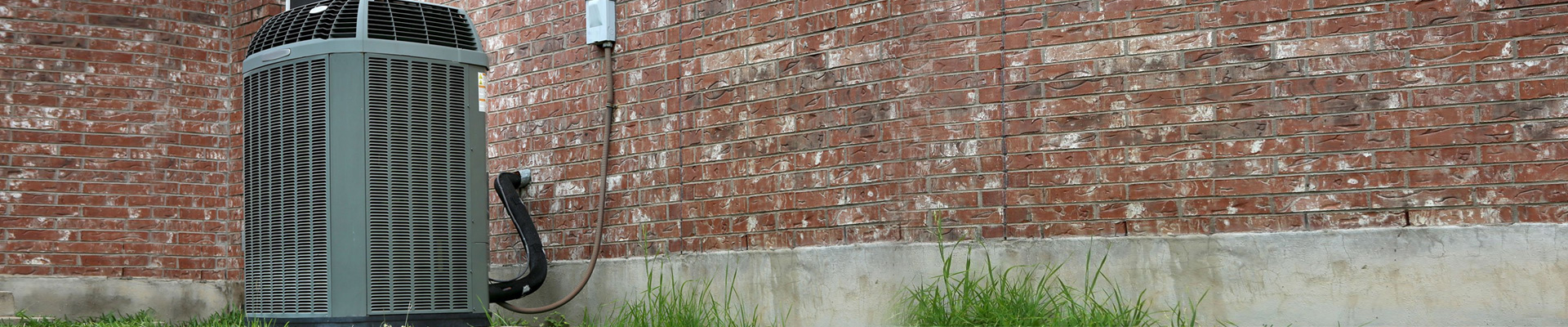
Walk outside and listen. If the indoor fan is blowing but the outdoor unit is silent, the system isn’t removing heat from your home, so the air will feel warm. The cause could be a tripped breaker, the disconnect, a failed capacitor or contactor, or a safety lockout. Learn more about why an outside AC unit stops working.
Don’t open the outdoor unit’s panels. They contain high-voltage parts and should only be serviced by a technician.
Staying cool while you wait
The Fairfax County Health Department shares several ways to keep cool without air conditioning:
- Use a cooling center. Fairfax County operates cooling centers during operating hours when its Extreme Heat Plan is activated, offering free, air-conditioned relief for anyone who needs it.
- Go somewhere air-conditioned. Libraries, malls and other indoor public places can help. The county notes that even a few hours in air conditioning can help lower your body temperature.
- Use cooling towels. Wet cloths or towels with cool water and place them on your head or neck.
- Limit heat at home. Avoid using the oven or stovetop.
- Make a misting fan. Spray cold water into a running fan to create evaporative cooling, and use fans together with other cooling strategies.
- Dress for the heat. Wear lightweight, loose-fitting, light-colored clothing.
Fairfax County also runs a Cooling Assistance Program to help keep vulnerable residents cool during the summer, and residents can sign up for Fairfax Alerts to get notified about heat emergencies.
Watch for signs of heat illness
A broken AC during a heat wave is most dangerous for older adults, young children and people with chronic medical conditions. Fairfax County notes that people with chronic medical conditions may struggle to cope with or recover quickly from extreme heat.
| Heat exhaustion | Heat stroke | |
| Body temperature | May be normal or slightly raised | Above 103°F |
| Skin | Cold, pale and clammy | Hot, red, dry or moist |
| Other signs | Heavy sweating, weakness, fast weak pulse, nausea, fainting | Rapid strong pulse, possible unconsciousness |
| What to do | Move to a cooler place, loosen clothing, apply cool wet cloths, sip water | Call 911 immediately, move to a cooler place, cool the body, don’t give fluids |
Based on CDC guidance as reported by ABC News.
Signs your AC Broke Down is an emergency
Call for service right away if:
- You smell burning or see smoke from the indoor or outdoor unit
- A breaker trips again after you reset it
- Water is leaking or the drain pan is overflowing
- Ice is forming on the lines or indoor unit
- Someone in the home is elderly, very young or medically vulnerable during a heat advisory
Fairfax County activates its heat plan when the National Weather Service issues a heat advisory, watch or warning, so if one is in effect, treat a broken AC as urgent.
What to tell the technician
Having these details ready helps the technician diagnose the problem faster and arrive with the right parts:
- What happened. When it stopped, and whether it stopped suddenly or gradually.
- What you’ve checked. Thermostat, breakers, disconnect, filter and drain pan.
- What you hear and see. Is the outdoor unit running? Is there water, ice, a smell or a noise?
- Error codes. Any codes on the thermostat or a flashing light on the indoor unit.
- System details. The brand and model number from the outdoor unit’s label, and roughly how old it is.
- Who’s at home. Mention anyone at risk from the heat, such as older adults, infants or someone who is ill.
- How to reach you. Your address, the best callback number and any access instructions.
AC stopped after a power outage or storm?
After a power outage or storm, give the system a few minutes before trying it. Honest Air recommends waiting a full five minutes, then confirming the thermostat is set to cool and below room temperature, checking that both the indoor and outdoor breakers are fully on, and making sure the outdoor disconnect pull-out is seated.
24/7 AC repair in Northern Virginia and Maryland
AVS provides 24/7 AC repair, 365 days a year, with same-day service and no extra charge for evenings, weekends or holidays. Site visits start at $90.
Areas we serve:
- Virginia: Arlington, Fairfax, Loudoun and Prince William counties
- Maryland: Montgomery and Prince George’s counties
Founded in 1991, AVS has served more than 50,000 residential and commercial customers across the Washington DC metro area. We’re licensed in Virginia (HVAC 2705039269A) and Maryland (HVAC 520714137895, Home Improvement 4192876).
Call 703-457-9028 (VA) or 301-686-7129 (MD).
How to keep it from happening again
Some breakdowns, like a clogged condensate drain that trips the float switch, can be caught early during routine service. A yearly AC tune-up before summer gives your system its best chance of making it through the hottest weeks.
Frequently Asked Questions
Why is my thermostat blank after my AC shut off?
A tripped float switch is a common cause. As one Florida HVAC contractor, Inlet, explains that many float switches are wired to break the low-voltage circuit that powers both the thermostat and the outdoor unit, so a trip can blank the thermostat entirely. Check the drain pan for water before replacing thermostat batteries or resetting anything.
Can I bypass the AC float switch to get cooling back?
Don’t. HVAC Laboratory notes that it’s technically possible to jumper the float switch wires, but doing so removes the protection that stops water from overflowing into your ceiling and floors. The switch tripped for a reason, so the drain line needs to be cleared by a technician instead.
Is it normal to have water in the AC drain pan?
A little, yes. HVAC Laboratory explains that a small amount of water in the drain pan is normal while the AC runs, but the pan should never be more than about one-quarter full, and water should drain away within minutes after the AC stops. Standing water or a full pan means the drain is clogged.
Will a fan keep me safe if my AC is broken?
Not in extreme heat. The CDC says electric fans may provide comfort, but when the temperature is in the high 90s, fans will not prevent heat-related illness. A cool shower or bath, or a few hours in an air-conditioned place like a library or mall, is a much better way to cool off until your AC is repaired.
How often should I check on older relatives during a heat wave?
At least twice a day. The CDC recommends visiting adults at risk at least twice a day and closely watching them for signs of heat exhaustion or heat stroke. That’s especially important for people 65 and older and anyone with heart disease or high blood pressure when the AC isn’t working.
What should I drink to stay safe while the AC is down?
Plenty of nonalcoholic fluids. The CDC advises drinking more fluids regardless of your activity level, without waiting until you’re thirsty, and avoiding drinks with alcohol or large amounts of sugar, which cause you to lose more body fluid. If your doctor limits your fluids, ask how much to drink in hot weather.
