VA 703-457-9028
 Apply for Financing
Last updated: October 2026
Smell gas? Don’t troubleshoot. Washington Gas advises leaving your home immediately, not searching for the source, and calling 911 and then the Washington Gas Emergency Leak Line at 844-WASHGAS (927-4427), option 1, from a safe place.
The most common sign of a bad furnace gas valve is a furnace that goes through its startup sequence, with the inducer motor running and the igniter glowing, but never lights. Other signs include clicking with no flame, burners that light and then go out, weak or uneven flames, frequent cycling and a gas smell near the furnace.
A gas valve is a safety-critical part, so testing and replacing it is always a job for a licensed technician.
No heat? AVS provides 24/7 furnace repair across Fairfax, Northern Virginia and Maryland, with no extra charge for evenings, weekends or holidays. Call 703-457-9028 (VA) or 301-686-7129 (MD).
What does a furnace gas valve do?
The gas valve controls the flow of natural gas or propane into your furnace’s burners. According to Bryant, it opens when it receives a low-voltage signal, typically 24 volts, from the furnace control board, which energizes a solenoid inside the valve and releases gas to the burners.
AVS describes the gas valve as the heart of the furnace, because it controls how much fuel reaches the burners. There are two main designs:
| Valve type | How it works | Where you’ll find it |
| Electronic ignition valve | Opens on a 24-volt signal from the control board | Most modern gas furnaces |
| Standing pilot valve | A pilot flame and thermocouple power the safety valve | Older furnaces with a constantly lit pilot |
The Furnace Outlet explains that on standing pilot systems, the pilot light and thermocouple supply the power that keeps the safety valve open. Either way, the valve is built to close if something goes wrong.
Gas valve, gas shut-off valve and gas meter: what’s the difference?
Homeowners often mix up these three parts. Knowing which is which tells you what you can safely touch.
| Part | Where it is | Who handles it |
| Gas meter | Outside or inside your home | Belongs to Washington Gas |
| Gas shut-off valve | On the gas pipe leading to the furnace | You can close it in an emergency |
| Furnace gas valve | Inside the furnace cabinet, behind the access panel | A licensed technician only |
The Furnace Outlet notes that you’ll find the furnace gas valve where the black metal gas pipe enters the furnace cabinet, usually as a small box with a switch or dial labeled “on” and “off.”
Signs of a bad gas valve
Several of these symptoms can also come from other parts, which is why a proper diagnosis matters before anything is replaced.
| Sign | What you’ll notice | Could also be |
| No flame at startup | The inducer runs and the igniter glows, but the burners never light | Igniter, flame sensor, gas supply |
| Clicking with no ignition | Repeated clicking from the furnace but no flame | Control board or wiring |
| Burners light, then go out | Flames appear briefly and shut off | Flame sensor, voltage or gas pressure dropout |
| Weak or uneven flames | Flames look small, irregular or unstable | Low gas pressure, dirty burners |
| Frequent cycling | The furnace turns on and off more than usual | Dirty filter, thermostat, overheating |
| Gas smell near the furnace | A rotten-egg odor near the unit, with or without a flame | A valve stuck partially open or a leak elsewhere |
Bryant explains that continuous clicking often means the control board is sending voltage to the valve, but its internal solenoids aren’t opening. Fox Family Heating & Air adds that problems appearing only after the furnace has run for a few minutes often point to a voltage or gas pressure dropout rather than a bad valve. Furnace Direct warns that a gas smell near a furnace that isn’t lighting can mean the valve is stuck partially open or one of its redundant valves has failed.
If your furnace keeps shutting down and refusing to restart, it may have gone into ignition lockout, which has several possible causes besides the gas valve.
Quick checks before you call
These checks are safe for homeowners and can rule out simple problems:
- Thermostat. Make sure it’s set to heat and the temperature is above the current room temperature.
- Gas shut-off valve. Confirm the shut-off on the gas pipe to the furnace is open.
- Other gas appliances. If your gas stove or water heater also isn’t working, the problem is likely your gas supply, not the furnace valve.
- Power. Check that the furnace power switch is on and the breaker hasn’t tripped.
Stop immediately if you smell gas at any point, and don’t open the furnace cabinet or adjust the gas valve itself.
How technicians test a gas valve
Technicians follow a set order to confirm whether the valve itself has failed or something else is to blame.
| Step | What the technician checks | Why it matters |
| 1. Wiring and ground | The low-voltage wiring that feeds the valve | Fox Family notes the valve depends on a clean 24-volt signal |
| 2. Voltage at the valve | Whether 24 volts reach the valve when it should open | Bryant says correct voltage with no opening means a defective solenoid |
| 3. Coil resistance | The valve’s internal coils, with power off | Furnace Direct notes an open or shorted coil keeps the valve closed |
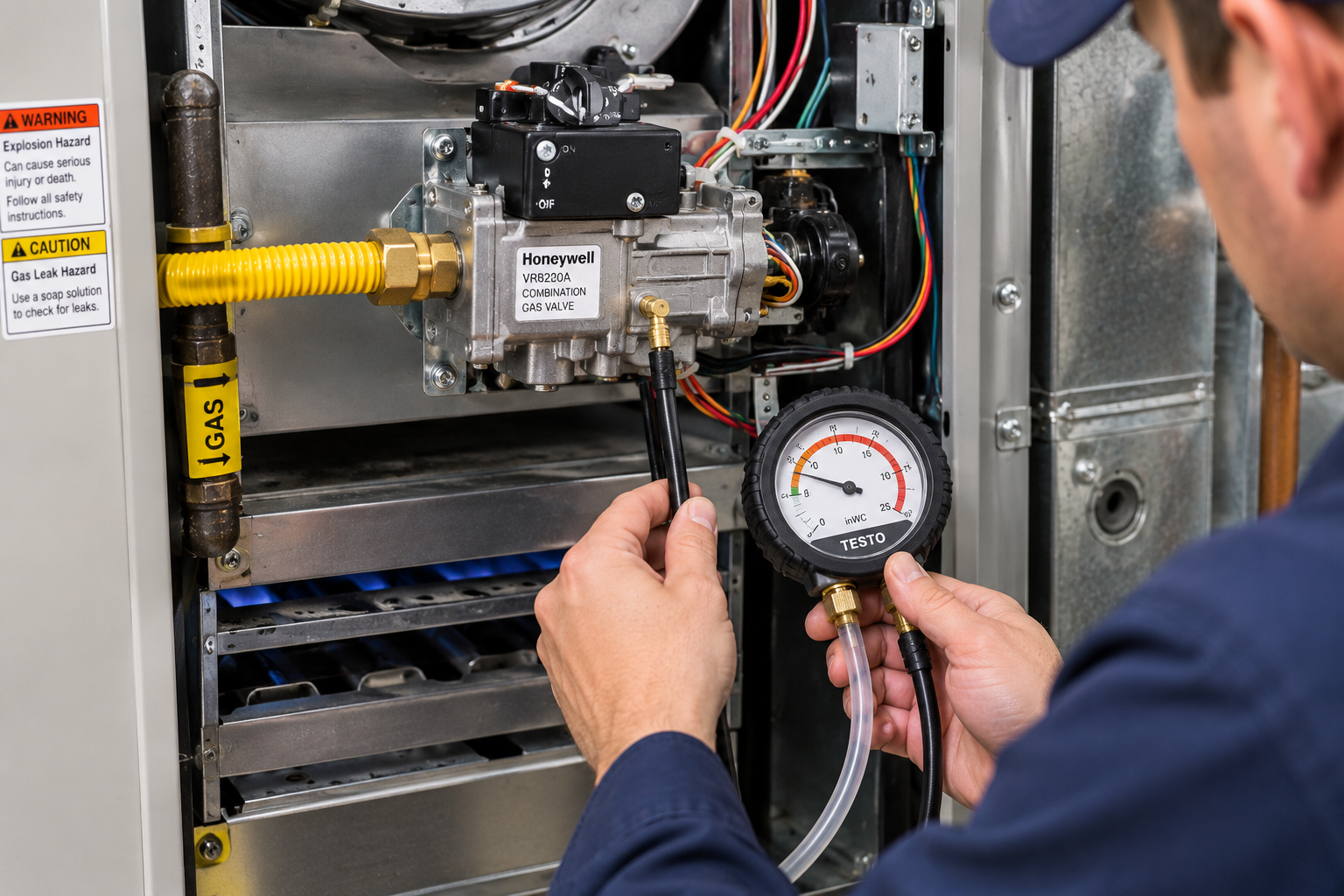
| 4. Gas pressure | Inlet and outlet pressure with a manometer | Fox Family cites inlet pressure of about 7 to 10 inches of water column and an outlet setting near 3.5 inches for natural gas |
Because this work involves live gas, electrical testing and precise pressure settings, it isn’t a DIY job.
How much does gas valve replacement cost?
On AVS’s website, gas valve repair is listed at around $200 to $1,000, depending on the valve’s condition and whether it needs repair or full replacement.
For context, AVS’s furnace repair pricing puts the average furnace repair at $289, with most homeowners paying between $131 and $458, and gas furnace repairs generally ranging from $375 to $1,200. For other common repairs, see our full guide to furnace repair costs.
What affects the final price:
- Valve type and brand. The replacement must match your furnace exactly.
- Fuel type. Natural gas and propane valves are calibrated differently.
- Furnace age and access. Older or hard-to-reach furnaces take more labor.
- Timing. Many companies charge more after hours, but AVS doesn’t charge extra for evenings, weekends or holidays.
Honeywell, White-Rodgers and Robertshaw: why the replacement must match
Most residential furnaces use a combination gas valve from one of a few manufacturers. SupplyHouse notes that Honeywell and Resideo valves are the most widely installed brand in U.S. residential heating equipment, alongside Robertshaw and White-Rodgers, and that connection size, BTU capacity and control voltage must be confirmed before ordering a replacement.
Furnace Direct lists some common pairings:
| Valve | Commonly found in |
| Honeywell VR8304M | Carrier, Bryant and Payne furnaces |
| White-Rodgers 36G | Trane, American Standard and some Lennox furnaces |
| White-Rodgers 36J | Older Rheem and Ruud furnaces |
National HVAC Parts adds that gas valves are calibrated for either natural gas or LP (propane), so a propane furnace needs an LP valve. The Furnace Outlet is blunt about it: gas valves aren’t interchangeable, and using the wrong one can harm your family and damage your furnace.
What happens during a gas valve replacement
A professional replacement follows these steps:
- Shut off the gas supply and power to the furnace.
- Disconnect and remove the old valve.
- Install a valve that exactly matches the furnace’s make, model and fuel type.
- Set the manifold gas pressure with a manometer to the furnace’s specification.
- Leak-test every connection with a soap solution, as National HVAC Parts describes.
- Run the furnace through a full ignition sequence to confirm safe operation.
Should you replace the gas valve or the whole furnace?
Age is the deciding factor. Furnace Direct notes that replacing a gas valve on a furnace under about 12 years old usually makes sense, but if the furnace is 15 or more years old, it’s worth considering the bigger picture. HomeAdvisor suggests considering a new system when a repair costs more than 50% of the price of a new unit.
Safety: when to shut off the gas
If you smell gas, your safety comes before the furnace. Washington Gas, which serves homes across Northern Virginia, Maryland and DC, gives clear instructions:
- Leave immediately. Get everyone out of the building.
- Don’t search for the source. Washington Gas specifically advises against trying to locate the odor.
- Call from a safe place. Call 911, then the Washington Gas Emergency Leak Line at 844-WASHGAS (927-4427), option 1.
Washington Gas adds an odorant called mercaptan so leaks smell like rotten eggs or sulfur, and it dispatches technicians around the clock to investigate gas odors. If your home is served by a different gas utility, call that utility’s emergency line instead.
Philadelphia Gas Works, a gas utility, also recommends installing a battery-operated carbon monoxide detector and having your furnace inspected every year.
When to call for furnace repair
Call a technician if the furnace won’t light, keeps shutting off, clicks without igniting, or produces weak or uneven flames. Call the gas utility first if you smell gas.
AVS provides 24/7 furnace repair across Northern Virginia and Maryland, with same-day service and no extra charge for evenings, weekends or holidays. Site visits start at $90.
Why Fairfax and Northern Virginia homeowners call AVS
- Founded in 1991, with more than 50,000 residential and commercial customers served across the Washington DC metro area
- 24/7 service, 365 days a year, with no extra charge for evenings, weekends or holidays
- Service for all major furnace brands, including Trane and Carrier
- Licensed in Virginia (HVAC 2705039269A) and Maryland (HVAC 520714137895, Home Improvement 4192876)
- Call 703-457-9028 (VA) or 301-686-7129 (MD)
Frequently Asked Questions
How long does a furnace gas valve last?
A typical furnace gas valve lasts about 10 to 20 years, according to Kelly Heating & Air. Many last as long as the furnace itself, but some fail early. How often the furnace runs, the quality of the gas supply and the overall condition of the system all affect how long the valve holds up.
Is it safe to run my furnace with a bad gas valve?
No. Furnace Part Source advises against running a furnace with a bad gas valve, because it can create a serious safety hazard, and a valve that doesn’t close properly can cause a gas leak. Shut the furnace off and have it inspected. If you smell gas, leave and call your gas utility first.
Can I replace a furnace gas valve myself?
It’s not recommended. Precision Mechanical warns that DIY gas valve repair can create a deadly gas leak if not done right and could void your warranty. Most states also require HVAC technicians to hold specific certifications to work on gas appliances, as HVAC Pricing Guide notes. A licensed technician should handle it.
Should a bad gas valve be repaired or replaced?
Usually replaced. Precision Mechanical and Jack’s Heating, Cooling, Stoves & Fireplaces both note that it’s usually recommended to replace a faulty gas valve rather than repair it. The valve’s internal parts are sealed and safety-critical, so a new, correctly matched valve is the safer and more reliable fix.
Does a furnace gas valve fail open or closed?
It’s designed to fail safe. Kelly Heating & Air explains that the furnace gas valve is engineered to close automatically when a problem arises, which prevents a dangerous gas leak. That’s why most failures leave you with no heat rather than a leak, though a valve can occasionally stick partially open.
How can I make my furnace gas valve last longer?
Keep the rest of the furnace in good shape. Furnace Direct recommends changing your air filter regularly, since a clogged filter makes the furnace cycle more and wears the valve’s solenoid faster. A yearly furnace tune-up that includes a gas pressure check can also catch a failing valve early.