
 VA 703-457-9028
 Apply for Financing
Last updated: October 2026
A gas stove burner usually won’t light because the burner is wet or dirty, the igniter electrode isn’t seated properly, or the burner cap and head aren’t matched up, according to GE Appliances. An electric burner usually won’t heat because of a burned-out element, a loose terminal connection, a failed burner switch or a tripped breaker. Start with these simple checks. Gas valve problems and glass-top elements need a technician.
| What you notice | Most likely cause | Section |
| Gas burner clicks but won’t light | Wet or dirty burner, misaligned cap | 1 |
| Clicking won’t stop, even with knobs off | Moisture or a failed spark switch | 2 |
| No clicking and no sound of gas | Breaker, spark switch or burner valve | 1, 6 |
| Yellow or orange flame | Incomplete combustion, clogged ports | 3 |
| Electric coil burner won’t heat | Element, terminal block or switch | 4 |
| Glass-top burner zone won’t heat | Element or switch | 4 |
| Burner only works on high or low | Burner control switch | 6 |
| Whole stove and oven dead | Power or gas supply | 5 |
Stove still not working? AVS repairs gas and electric stoves, ranges and ovens across Northern Virginia and Maryland. Call 703-457-9028 (VA) or 301-686-7129 (MD).
1. Gas burner won’t ignite
When a gas burner won’t light, first listen as you turn the knob to Lite.
- If you hear clicking: the igniter is working, so the problem is usually the burner itself.
- If you hear nothing: check the circuit breaker for the stove. The igniters run on electricity even on a gas stove.
GE Appliances recommends these steps for a burner that clicks but won’t light:
- Turn off the burner and let the cooktop cool.
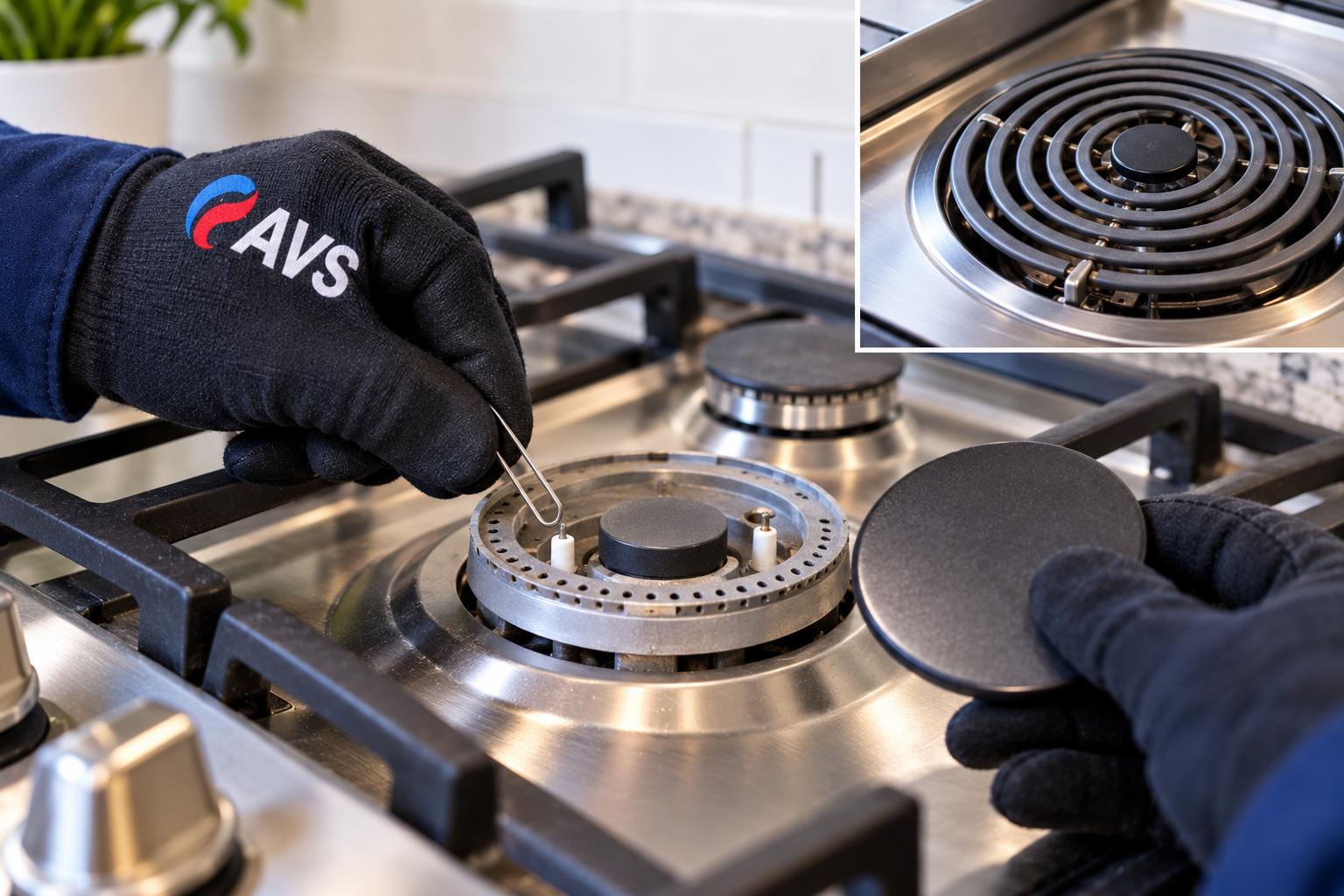
- Remove the grate, burner cap and burner head. Use a needle or paper clip to clear debris from the burner holes.
- Clean and press down the electrode. Even if it looks clean, wipe the tip of the igniter electrode with a clean, dry paper towel and press it down.
- Reassemble carefully. Make sure each burner cap matches its burner head and lies flat. A cap that doesn’t sit properly keeps the igniter from lighting the gas evenly.
- Test the burner again.
If you’ve recently cleaned the cooktop, the burner may simply be wet. GE notes that after cleaning, you should let the burner heads and caps air-dry thoroughly or set them in a warm oven for 30 minutes before putting them back.
If the igniter clicks and the burner is clean, dry and seated, but you still don’t hear gas flowing when you turn the knob, the surface burner valve may be faulty, as Repair Clinic notes. Gas valve repairs need a technician.
2. Why does my gas stove keep clicking?
A gas stove that keeps clicking is usually dealing with moisture, not a broken part. GE explains that if the burners were recently cleaned, moisture in the burner head’s ignition port can make the burner click continuously without lighting until the ports dry out.
If the clicking continues even when every knob is turned off, Cooktop Hunter advises turning off power at the breaker right away and calling for service. Constant clicking with the knobs off often points to moisture in a spark switch or a failed spark module.
If only one burner won’t spark while the others work, Repair Clinic notes that the spark ignition switch for that burner is the likely culprit.
3. Weak, uneven or yellow gas flame
Flame color tells you how well your stove is burning gas. According to fire safety guidance from the City of San Marcos, based on San Diego Gas & Electric’s natural gas safety information, a pilot or burner flame should be about 90 percent blue, and a yellow flame means the appliance isn’t working right and could be giving off harmful fumes.
| Flame | What it means | What to do |
| Steady blue, maybe a tiny yellow tip | Normal, complete combustion | Nothing |
| Uneven or lifting flame | Misaligned cap or clogged ports | Clean and reseat the burner |
| Mostly yellow or orange | Incomplete combustion | Clean the burner; if it stays yellow, call a technician |
| Weak flame on every burner | Gas supply or pressure problem | Call your gas utility or a technician |
The Daily Meal notes that while an occasional lick of yellow is fine, a flame that constantly burns yellow and orange means it’s time to call a professional, because long-term incomplete combustion can release too much carbon monoxide. Install a carbon monoxide alarm if you cook with gas.
4. Electric element not heating
Coil burners
GE Appliances, as summarized by Sears Home Services, recommends unplugging the stove, making sure the burner is cool, and pushing a coil element all the way into its terminal block, since a loose connection can stop the burner from working.
Then try the swap test:
- Unplug the stove or turn off its breaker, and let the burners cool.
- Unplug the non-working coil from its socket.
- Plug it into the terminal block of a burner that works.
- Turn the stove back on and test it.
If the coil heats in the working location, the element is fine, and the burner switch or wiring for the original location needs repair. If it doesn’t heat anywhere, the element needs replacing.
Axis Repair lists the most common causes of an electric burner that won’t heat as a burnt-out heating element, a failed infinite switch, a bad burner socket and a loose terminal connection.
Glass-top (radiant) burners
Smooth glass-top stoves have their heating elements sealed under the glass, so there’s no swap test. Sears Home Services notes that on a GE electric stove with a ceramic glass top, you’ll likely need a technician to diagnose and replace a failed element. Never use a glass-top stove with a cracked surface.
5. Stove and oven both not working
When the cooktop and the oven both fail at the same time, the problem is usually something they share.
| Range type | Most likely shared cause | What to check |
| Electric range | Tripped or half-tripped 240-volt breaker, or a loose power cord | Reset the double-pole breaker fully off and on |
| Gas range | Power to the igniters and controls, or the gas supply | Check the breaker and confirm the gas shut-off valve is open |
| Either type | Control lock on electronic models | Check the owner’s manual |
On an electric range, the display and lights can still work when only half of the double-pole breaker trips, while the burners and oven elements won’t heat. If only the oven has a problem, see our guide to why your oven isn’t working.
6. Control and switch problems
Every burner has a control behind its knob. On electric stoves, it’s usually an infinite switch, also called a surface element switch. On gas stoves, a spark ignition switch sends power to the igniter.
Sears Home Services explains that a bad surface element switch can make the element hard to turn on or off, the switch shaft may feel loose or wobbly, and the burner may heat unevenly or never reach the right temperature. A burner that only works on high, or won’t turn off, usually points to the switch rather than the element. Switch repairs involve live wiring, so they’re best handled by a technician.
Gas vs electric stove: which problems apply to yours?
| Problem | Gas stove | Electric stove |
| Wet or dirty burner | Common cause | Not applicable |
| Igniter or spark switch failure | Yes | Not applicable |
| Surface burner valve failure | Yes | Not applicable |
| Burned-out element | Not applicable | Common cause |
| Loose terminal block | Not applicable | Coil models |
| Burner control switch failure | Spark switch | Infinite switch |
| Tripped breaker | Igniters stop working | Burners stop heating |
| Yellow or weak flame | Yes | Not applicable |
When to stop and call for stove repair
Call a technician if:
- You smell gas. Leave the home immediately and call 911 and your gas company from outside.
- The stove keeps clicking with all the knobs off
- You notice a burning or electrical smell
- A glass-top surface is cracked
- The breaker trips again after you reset it
- A flame stays yellow or orange after cleaning
- A burner won’t turn off
Should you repair or replace your stove?
Repair is usually worth it. Mr. Appliance notes that stove and oven repair is often more affordable than replacing the entire unit, especially if the appliance is under 15 years old. Common fixes like igniters, coil elements, burner switches and spark modules are usually single-part repairs. If an older stove needs major repairs like a glass-top replacement and a control board, compare the repair against a new range.
Why Northern Virginia homeowners call AVS for stove repair
AVS provides gas and electric oven, stove and range repair with prompt service, coming to your home or office throughout Northern Virginia and Montgomery and Prince George’s counties in Maryland. Stoves are part of our full range of household and commercial appliance repair. Homeowners in Prince William County can also see our local appliance repair in Woodbridge page.
- Founded in 1991, serving the Washington DC metro area
- Repairs for gas and electric stoves, ranges and ovens
- Call 703-457-9028 (VA) or 301-686-7129 (MD)
Frequently Asked Questions About Gas or Electric Stove Not Working
Can I use my gas stove during a power outage?
Yes, the cooktop burners. GE Appliances explains that you can light the surface burners on an electric-ignition gas cooktop with a match by holding a lit match next to the burner and turning the knob to Low. The gas oven can’t be lit during an outage, because its igniter and gas valve need power.
What should I do with my electric stove during a power outage?
Turn every burner knob to Off. GE Appliances notes that electric coil, radiant and induction burners won’t operate during a power outage, and burners controlled by knobs can come back on when the power returns if they were left on. Burners with digital touch controls won’t come back on by themselves.
Why won’t my induction cooktop heat some pans?
The pan probably isn’t magnetic. GE Appliances explains that induction burners won’t turn on if a pan isn’t made of a ferrous, magnetic material or is too small, and the power level will flash for 25 seconds and then turn off. Hold a magnet to the bottom of the pan. If it sticks, the pan should work.
Can I use my gas stove to heat my home?
No. Fire safety guidance from the City of San Marcos, based on San Diego Gas & Electric’s natural gas safety information, warns never to use a gas stove for heating, because it can damage the stove and produce dangerous carbon monoxide. If your home isn’t warm enough, have your furnace or heat pump checked instead.
Why is my gas stove flame yellow instead of blue?
A yellow or orange gas stove flame usually indicates incomplete combustion caused by clogged burner ports, a misaligned burner cap, or an airflow problem. Clean and reseat the burner components first. If the flame remains yellow after cleaning, stop using the burner and contact a qualified technician, as improper combustion may create safety concerns. Pasted markdown
Why does my stove burner only work on high or low heat?
A burner that only works on high heat, low heat, or cannot maintain the correct temperature may have a faulty burner control switch. On electric stoves, this is often related to the surface element switch, while gas stoves may have ignition switch or control issues. Switch-related repairs involve electrical components and should be handled by a technician.
