
 VA 703-457-9028
 Apply for Financing
Furnace ignition lockout is a safety shutdown. When a gas furnace tries to light and can’t confirm a safe flame, its control board stops the ignition sequence and locks the furnace out so unburned gas can’t build up. The most common causes are a dirty flame sensor, a failed igniter, a gas supply problem, blocked vents or overheating from a clogged filter.
You can safely check a few things and reset the furnace once. If it locks out again, the cause needs a technician.
| Lockout type | What happens | What you can do |
| Soft lockout | The furnace stops after a failed ignition but can try again | Check the basics, then reset once |
| Hard lockout | Repeated failed attempts, and the furnace stays off | Call a technician to find and fix the cause |
No heat right now? AVS provides 24/7 furnace repair across Northern Virginia and Maryland, with no extra charge for evenings, weekends or holidays. Call 703-457-9028 (VA) or 301-686-7129 (MD).
What does ignition lockout mean?
Every time your thermostat calls for heat, a gas furnace runs through a set sequence. According to PickHVAC, the inducer motor starts and pre-purges the heat exchanger, the pressure switch closes, the igniter lights, the gas valve opens, the burners light, the flame sensor proves the flame, and then the blower starts.
If any step fails, the control board stops the sequence for safety. When it fails repeatedly, the furnace goes into lockout and stays off until it’s reset. It won’t restart until the problem that triggered the shutdown is fixed and the furnace is reset.
Soft lockout vs hard lockout: what’s the difference?
Trane describes a soft lockout as the first one or two times the furnace controller stops the ignition sequence. If it happens a third time, the furnace enters a hard lockout.
| Soft lockout | Hard lockout | |
| When it happens | After one or two failed ignition attempts | After repeated failures, often the third |
| Will the furnace try again? | Yes, usually | No, it stays off |
| Who should reset it | You can try one reset after basic checks | A technician, after finding the cause |
Trane is clear that once a furnace is in hard lockout, you’ll need a technician to resolve the cause and then reset the furnace.
Check these first: 1-minute checks before you reset
Before you reset anything, rule out the simple causes:
- Thermostat. Make sure it’s set to heat, the temperature is above the current room temperature, and the batteries aren’t dead.
- Air filter. A clogged filter can cause the furnace to overheat and shut down.
- Furnace power. Check that the power switch near the furnace is on and the breaker hasn’t tripped.
- Gas valve. Make sure the shut-off valve on the gas line to the furnace is open.
- Outdoor vent pipes. On high-efficiency furnaces with white PVC pipes outside, make sure snow, leaves or debris aren’t blocking them.
If you smell gas, don’t reset anything. Leave the house and call your gas company or 911 from outside.
Common causes of furnace ignition lockout
1. Dirty or faulty flame sensor
The flame sensor proves that a flame is present after the gas valve opens. If it’s coated with residue, it can’t detect the flame, so the control board shuts off the gas within seconds. PickHVAC notes that cleaning the sensor is often effective, and a technician can also check the grounding and wiring that the sensor signal depends on.
2. Failed igniter
The igniter lights the gas and should activate within seconds of the furnace starting, as S&M Mechanical Services explains. When it cracks or wears out, the burners never light and repeated failures lead to an ignition lockout. A technician can test the igniter and replace it if needed.
3. Gas supply problems
If the gas valve to the furnace is off, or gas pressure is too low, the furnace tries to light and fails. Hunker points out that gas lines have on/off valves just like water lines, so check the valve before calling. A failing gas valve inside the furnace can cause the same symptom, and it’s a job for a technician. Learn the warning signs of a bad gas valve in your furnace.
4. Blocked intake or exhaust vents
High-efficiency furnaces draw air in and push exhaust out through PVC pipes. Advanpro explains that in very cold or snowy weather, snow and ice can block the intake pipe, and pressure switches then shut the furnace down because there isn’t enough combustion air. If there’s loose snow, you may be able to clear it by hand, but Advanpro’s venting guide warns not to break or chip away solid ice. Call a technician instead. Animals, leaves and nests can cause the same problem.
5. Clogged condensate drain
High-efficiency furnaces produce water as they run, which drains away through a trap and tubing. Hunker notes that a blocked condensate drain is a problem specific to high-efficiency units. When water can’t drain properly, the furnace’s safety controls can shut it down.
6. Overheating from restricted airflow
If the burners light and then shut off after a few minutes, the furnace may be overheating. PickHVAC explains that a dirty filter or closed registers raise the temperature inside the furnace until the high limit switch cuts the gas to protect the heat exchanger. Repeated limit trips can end in lockout.
7. Faulty pressure switch or inducer motor
The inducer motor creates the draft that closes the pressure switch. Furnace Prices explains that if the inducer motor fails or struggles, or its port or hose clogs, the switch won’t close and the furnace won’t ignite.
8. Cracked heat exchanger
A&A Cooling & Heating notes that a cracked or badly deteriorated heat exchanger will cause the furnace to shut down. This is a serious problem because of the carbon monoxide risk, so it always needs a professional inspection.
How to reset a furnace in lockout safely
Reset procedures vary by manufacturer, so check the label inside your furnace door or your owner’s manual first. In general:
- Fix anything you found in the 1-minute checks, such as replacing the filter or clearing snow from the vents.
- Turn off power to the furnace at the power switch or breaker.
- Wait at least 30 seconds. PVC Vent Screens notes that most furnaces reset when power is turned off for thirty seconds or longer and then turned back on. Trane adds that some manuals instead call for turning the power on and off twice within 30 seconds.
- Turn the power back on and set the thermostat to call for heat.
- Watch and listen. The inducer should start, then the igniter should glow and the burners should light.
Reset the furnace once. If it locks out again, stop and call a technician.
How to read your furnace’s LED error code
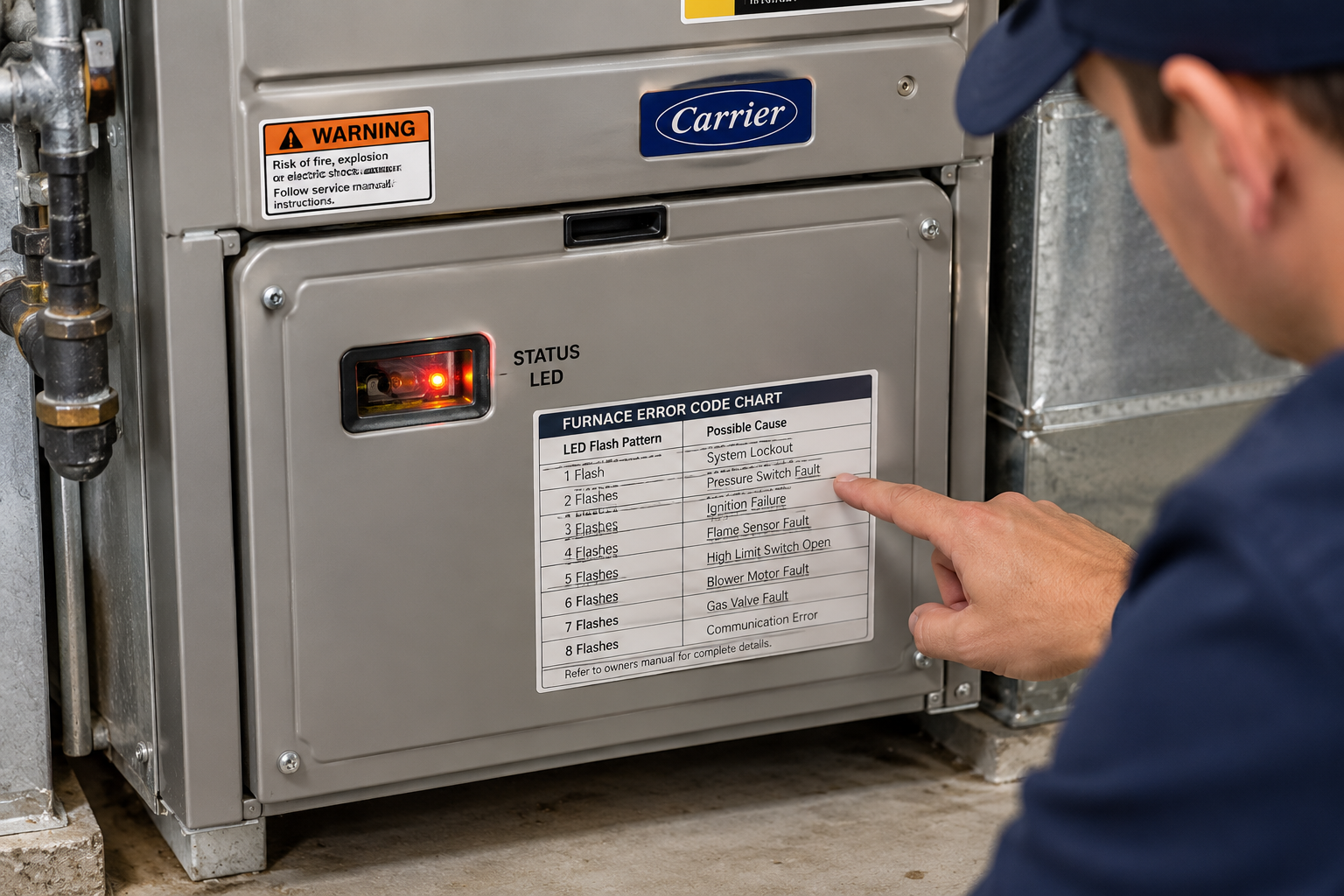
Many furnace models have a status light or display that shows an error code when the furnace locks out, as PVC Vent Screens notes. On most, a light on the control board is visible through a small window in the lower panel, and its blink pattern matches a code chart that’s often printed inside the furnace door.
- Count the blinks before you turn the power off, in case the reset clears the code.
- Take a photo of the blinking light and the code chart.
- Share both with your technician. It helps them diagnose the problem faster.
Codes differ from brand to brand, so always use the chart for your specific furnace rather than a generic list.
When to call a technician
Call a professional if:
- The furnace locks out again after one reset
- You’ve reached a hard lockout
- You smell gas or a CO alarm has gone off (leave the house first)
- The intake or exhaust pipe is frozen solid
- The error code points to the flame sensor, igniter, gas valve, pressure switch or limit switch
- You see soot, scorch marks or water pooling around the furnace
AVS provides 24/7 furnace repair across Northern Virginia and Maryland, with same-day service and no extra charge for evenings, weekends or holidays. Site visits start at $90. For typical prices on parts like flame sensors, igniters and gas valves, see our furnace repair costs guide.
Why Northern Virginia and Maryland homeowners call AVS for furnace repair
- Founded in 1991, with more than 50,000 residential and commercial customers served across the Washington DC metro area
- 24/7 service, 365 days a year, with no extra charge for evenings, weekends or holidays
- Service for all major furnace brands, including Trane and Carrier
- Licensed in Virginia (HVAC 2705039269A) and Maryland (HVAC 520714137895, Home Improvement 4192876)
- Call 703-457-9028 (VA) or 301-686-7129 (MD)
Frequently Asked Questions
What does “ignition lockout due to retries” mean?
It means your furnace tried to light several times, couldn’t confirm a flame, and locked itself out. Many furnaces allow about three ignition attempts before entering lockout, as Action Air Conditioning & Heating explains. The message tells you ignition failed repeatedly, but not why, so the flame sensor, igniter and gas supply still need checking.
Can I clean the furnace flame sensor myself?
It’s possible, but it’s usually best left to a technician. BVS Home Experts advises against cleaning or replacing the sensor yourself, since it involves opening the burner compartment of a gas appliance. A technician can also check the sensor’s wiring and ground connection, which cleaning alone won’t fix.
What happens if I keep resetting my furnace?
Repeated resets can push the furnace into a hard lockout. BVS Home Experts notes that too many restart attempts can force the system into a hard lockout, which then needs a technician to reset. Resetting also doesn’t fix the underlying cause, so the furnace will keep shutting down until the problem is repaired.
Why does my furnace light and then shut off after a few seconds?
When burners light and go out within seconds, the furnace usually can’t prove the flame. PickHVAC lists a dirty flame sensor, a loose ground, low gas flow or a pressure switch problem as common reasons. If the burners run for a few minutes before shutting off, overheating from poor airflow is more likely.
How can I prevent furnace ignition lockouts?
Trane says the easiest way to avoid a furnace lockout and many other furnace problems is to change your filters regularly. A yearly professional furnace tune-up before winter also lets a technician clean the flame sensor, check the igniter and clear the condensate drain before cold weather arrives.
