
 VA 703-457-9028
 Apply for Financing

A cracked furnace heat exchanger can let combustion gases, including carbon monoxide, mix with the air in your home. If you notice a changing flame, soot, a metallic smell, rattling when the burners start or a carbon monoxide alarm, turn the furnace off and call a licensed technician. AVS offers a free second opinion, 24/7: Virginia 703-457-9028, Maryland 301-686-7129.
If your carbon monoxide alarm is sounding right now: move everyone, pets too, outdoors and call 911 from there. Keep the furnace off until a technician has checked it.
Written by the AVS Heating and Air Conditioning team. Virginia HVAC license 2705039269A, Maryland HVAC license 520714137895.
What Is a Furnace Heat Exchanger?
A furnace heat exchanger is the set of metal chambers or tubes between the burner flames and the air that circulates through your home. The burners heat the metal, and the blower pushes household air across the outside of it, so the air warms up without ever touching the combustion gases, which leave through the flue. When that metal cracks, the barrier between the two airstreams is gone.
7 Signs of a Cracked Furnace Heat Exchanger
No single sign proves a crack, but several together are a reason to stop and call. Here is what to look for, and how urgent each one is.
| Sign | What it can mean | What to do |
| The flame changes shape or color, flickers, or leans when the blower starts | Gases may be escaping through a crack and disturbing the flame | Turn the furnace off and call |
| Soot around the burners, vents or flue | Incomplete combustion | Do not clean it yourself. Call for an inspection |
| A strong metallic, chemical or formaldehyde-like smell | Combustion gases reaching the airflow | Turn the furnace off and call |
| Rattling, popping or banging when the burners start | Metal expanding and contracting around a crack | Call before the next cycle |
| Carbon monoxide alarm that keeps sounding | Possible leak | Leave the house if it sounds, then call |
| Headaches, dizziness or nausea that ease when you leave the house | Possible carbon monoxide exposure | Get fresh air first, then call |
| Visible rust, corrosion, cracks or gaps | Metal failure | Call for an inspection |
Weak heat and rising heating bills can also go with a damaged heat exchanger, but they are common to many furnace problems, so treat them as supporting clues.
Is It Really Cracked? Look-Alike Problems
Several ordinary furnace problems resemble a cracked heat exchanger. Telling them apart is a job for a technician with the right tools.
| What you see | A non-crack cause | Why a technician checks it |
| Yellow or flickering flame | A dirty burner | The same flame can come from a crack |
| Furnace turns on and off quickly | A dirty filter, blocked vents or an oversized furnace | These also stress the heat exchanger |
| A carbon monoxide alarm | A blocked flue or another gas appliance | A reading alone does not locate the source |
If any of these appear, a visit from AVS finds the real cause and tells you plainly whether it is the heat exchanger.
Can You Run a Furnace With a Cracked Heat Exchanger?
No. A furnace with a suspected cracked heat exchanger should stay off until a technician has inspected it, even if it still heats well. A crack can leak carbon monoxide without any visible warning, and the furnace working normally does not make it safe. If it is cold, call our 24/7 line and tell us how cold the house is, so we can plan the visit around it.
Why a Cracked Heat Exchanger Is a Carbon Monoxide Risk
Carbon monoxide is a gas you cannot see or smell, and the CDC says its symptoms, such as headache, dizziness, weakness and nausea, are often mistaken for the flu. The CDC also notes that people who are sleeping can be harmed before they notice any symptoms. Our guide on whether a furnace can cause carbon monoxide poisoning covers symptoms, detector placement and what to do when an alarm sounds.
What Causes a Heat Exchanger to Crack?
According to Trane, the main causes are the following.
Wear and tear Repeated heating and cooling slowly fatigue the metal over the years.
Overheating A dirty filter, closed vents or restricted airflow make the furnace run hot, which stresses the heat exchanger.
An oversized furnace A furnace that is too large for the house cycles on and off more often, adding stress.
Rust and corrosion Moisture and age eat away at the metal.
How Technicians Confirm a Cracked Heat Exchanger
A visual glance is not enough, because a crack can sit where nobody can see it. A thorough check usually combines several methods.
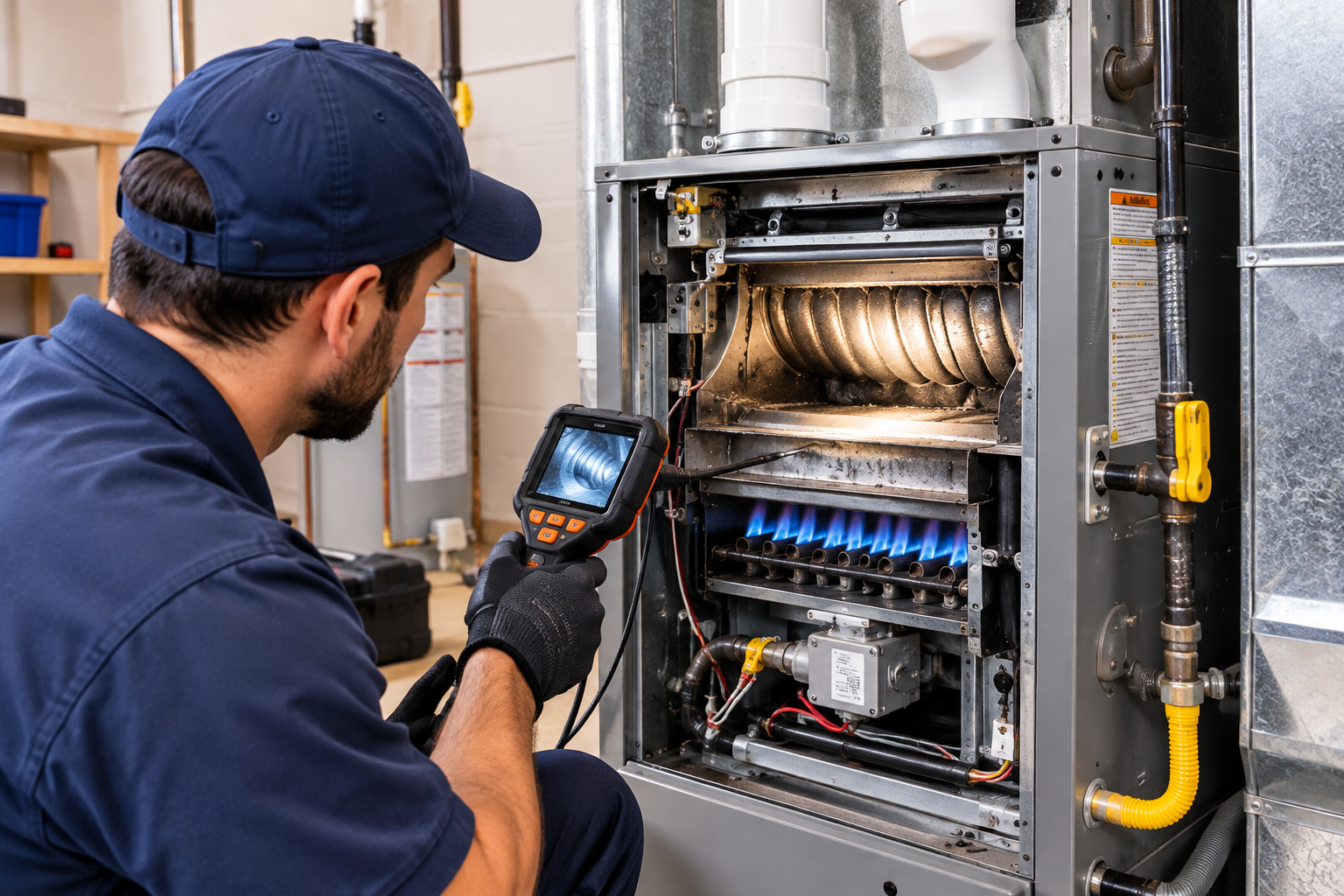
Camera inspection A small camera looks inside the heat exchanger for cracks, gaps and separated seams.
Flame test The technician watches how the flame behaves when the blower starts, since a crack can disturb it.
Combustion and carbon monoxide readings Instruments measure the exhaust and the air your home receives.
Full furnace inspection Burners, venting, filter and airflow are checked, since they affect heat exchanger damage.
Cracked Heat Exchanger Repair and Replacement Cost
According to AVS’s furnace repair cost guide, heat exchanger repair typically costs $100 to $200, and heat exchanger replacement typically costs $500 to $1,500. Your price depends on the furnace model, the type of heat exchanger and what the inspection finds, so we give you the number before any work begins.
| Option | Typical AVS guide range | Best when |
| Heat exchanger repair | $100 to $200 | The problem is minor and found early |
| Heat exchanger replacement | $500 to $1,500 | The furnace is otherwise in good shape |
| New furnace | Quoted after inspection | The furnace is old or has several other faults |
Repair or Replace: Heat Exchanger vs New Furnace?
The right choice depends on what else is wrong with the furnace.
Replace the heat exchanger Makes sense when the furnace is otherwise reliable, runs well and has been maintained.
Replace the furnace Makes sense when it is old, has had repeated breakdowns or needs other major repairs at the same time.
Compare the numbers Ask for both options in writing, so you can weigh the cost of a new heat exchanger against the cost of a new furnace. Our furnace repair team can walk through both, and our furnace installation team can price a new unit if that is the better route.
Free Second Opinion on a Cracked Heat Exchanger in Northern Virginia and Maryland
Told your heat exchanger is cracked and unsure whether to trust it? AVS is a repair-first company, and we give a free second opinion on cracked heat exchangers across Northern Virginia, Montgomery County and Prince George’s County in Maryland, and Washington DC. We visit at no charge, inspect the heat exchanger and tell you what we find. Contact AVS to book.
Emergency Furnace Repair When It’s Cold
A furnace that has to stay off in January cannot wait until Monday. Our emergency line is open any hour, every day of the year, with no extra charge for evenings, weekends or holidays, and our offices in Fairfax, Falls Church and Bethesda keep a technician close to your home. Whether the problem is a suspected crack or another no-heat fault, call and we will send help.
How to Prevent a Cracked Heat Exchanger
You cannot stop a furnace from ageing, but you can avoid the overheating that speeds up damage.
Change the filter A dirty filter is one of the most common causes of overheating, so replace it on schedule.
Keep vents open Closed or blocked registers restrict airflow.
Book an annual furnace tune-up The CDC advises having heating systems checked by a qualified technician every year, and a yearly service lets us catch early wear before it turns into a crack.
Areas We Serve
AVS helps homeowners with furnace repair and heat exchanger inspections from offices in Fairfax, Falls Church and Bethesda.
Northern Virginia Alexandria, Annandale, Arlington, Ashburn, Burke, Centreville, Chantilly, Clifton, Dunn Loring, Fairfax, Falls Church, Franconia, Gainesville, Great Falls, Herndon, Manassas, McLean, Oakton, Reston, Springfield, Sterling, Vienna and Woodbridge.
Maryland Aspen Hill, Bethesda, Bowie, Burtonsville, Clarksburg, College Park, Damascus, Darnestown, Derwood, Fort Washington, Gaithersburg, Germantown, Montgomery Village, Olney, Potomac, Rockville, Silver Spring and Wheaton.
Frequently Asked Questions
How long does a furnace heat exchanger last?
According to Trane, a heat exchanger should last 10 to 15 years or more with good maintenance. A crack is less likely in a newer furnace that has been serviced, and more likely in an older one that has run hot.
Is a cracked heat exchanger a scam?
A cracked heat exchanger is a real safety fault, but homeowners are right to want proof. Ask the technician to show you the crack on a camera photo or video, and to explain how they found it. Be cautious of anyone who pressures you to buy a new furnace the same day without showing you evidence, and get a second opinion before you commit.
Can I test for a cracked heat exchanger myself?
You can look for warning signs such as soot, rust and flame changes, but you cannot reliably confirm a crack at home. Videos that show matchsticks, flame tricks or meter readings are no substitute for a camera inspection and combustion testing, and doing them yourself can put you at risk. If you suspect a crack, turn the furnace off and call.
Does a warranty cover heat exchanger replacement labor?
Warranty terms depend on the manufacturer and model, and a warranty often covers the part but not the labor. Because the furnace has to be largely taken apart for the swap, labor can be a large share of the bill. Ask for the warranty terms in writing along with your estimate.
Can a brand-new furnace have a cracked heat exchanger?
It is uncommon, but it can happen. Trane names overheating and an oversized furnace as causes of cracks, and both can affect a newly installed furnace. If a new furnace is reported to have a cracked heat exchanger, get a second opinion and check the warranty.
How long does it take to replace a furnace heat exchanger?
Plumbline Services says a replacement can take up to 8 hours of work, since the furnace must be largely taken apart first. Ask your technician for a time estimate on your furnace, so you know how long the heat will be off.
Get a Free Second Opinion on Your Heat Exchanger
If you suspect a cracked heat exchanger, or someone has told you the furnace needs replacing, call AVS Heating and Air Conditioning before you decide. We inspect the furnace, show you what we find and give you a clear price, any hour of the day.
Virginia: 703-457-9028. Maryland: 301-686-7129.
